

Tech neck exercises are a short routine of chin tucks, deep neck flexor nods, neck isometrics and shoulder strengthening. The best-supported part is the strengthening. A 2015 Cochrane review found moderate-quality evidence that strength training eases chronic neck pain, and expected no benefit from stretching alone.
The evidence behind the fear is mixed. A 150-person study of students found no association between texting neck posture and neck pain; a larger Swedish cohort found links. Exercise has moderate-quality support for chronic neck pain.
Your tech neck exercise routine at a glance
| Exercise | Sets | Reps or hold | Closest trial evidence |
|---|---|---|---|
| Seated chin tuck | 2 | 10 reps, 5 second hold | Craniocervical flexor training (Falla 2007) |
| Lying chin nod | 1 | 5 reps, 10 second hold | Low-load deep flexor exercise (Jull 2002) |
| Neck isometrics: forehead, each side, back of head | 1 per direction | 5 reps, 5 second push | Isometric neck strengthening (Ylinen 2003) |
| Shoulder shrug with light weights | 2 | 10 reps | Trapezius strength training (Andersen 2008) |
| Band row | 2 | 10 reps | Elastic tubing training (Andersen 2011) |
Do the routine 5 days a week, about 10 minutes in all. These doses are starting points. The trial abstracts cited here do not report hold times or reps for individual moves, so no study shows that 5 seconds beats 3.
How to do each tech neck exercise
Seated chin tuck
- Sit tall with your eyes level and your shoulders relaxed.
- Glide your head straight back, as if making a double chin, without tipping your chin down.
- Hold for 5 seconds, release, and repeat for 10 reps.
No abstract here tested the chin tuck by name; the trials tested craniocervical flexor training, a gentle nodding motion.
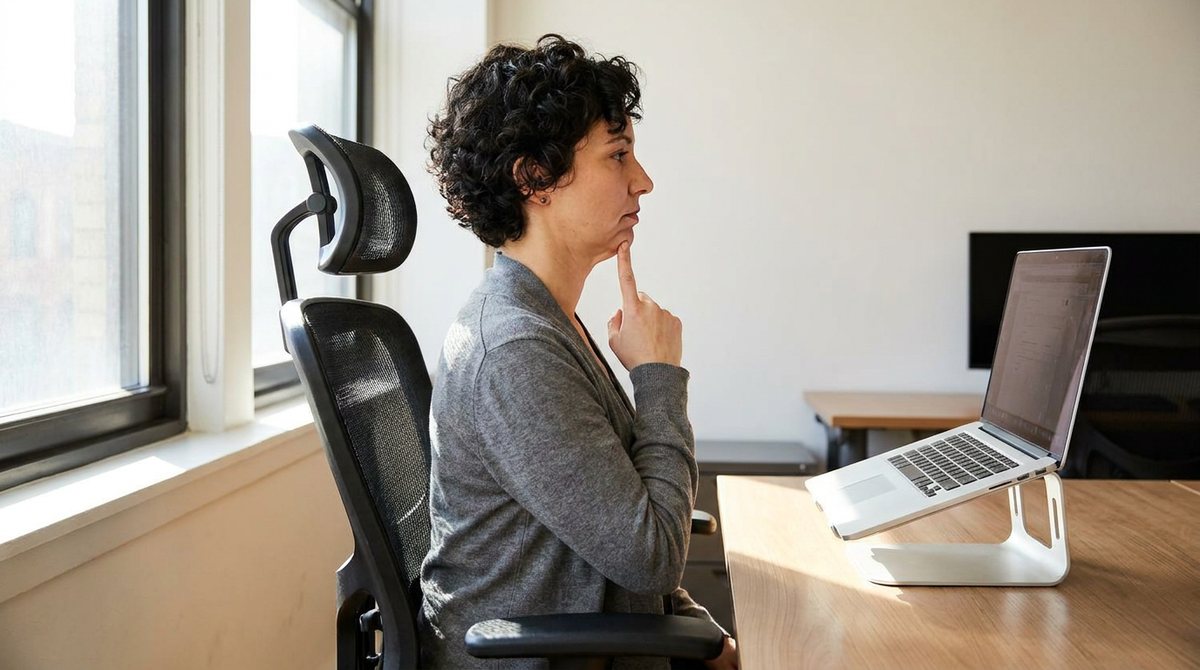
Lying chin nod
Lie on your back with your knees bent and a thin towel under your head. Nod as if saying a small yes, keeping your head on the towel, and hold for 10 seconds with light effort.
Neck isometrics
Press your palm into your forehead, hold the push for 5 seconds at about half effort, and keep your head still. Repeat with your hand at each side of your head, then with both hands behind it.
Ylinen 2003 used high-intensity work against an elastic band, so pushing into your own hand is a lighter load.
Shoulder shrug and band row
For shrugs, hold a light weight in each hand, lift your shoulders toward your ears, pause, and lower slowly. For rows, anchor a band at chest height, pull your elbows back and squeeze your shoulder blades together.
The Andersen abstracts do not list specific exercises, so shrugs and rows are common ways to load the same muscles, not the trial protocols. For chest and mid-back work, see our guide to posture exercises for desk workers.
Do tech neck exercises work? What the trials found
| Study | Who | What it found |
|---|---|---|
| Gross 2015, Cochrane Database Syst Rev | 27 trials, 2,485 analyzed participants | Moderate-quality evidence that strength training eases chronic neck pain (pooled SMD -0.71, 95% CI -1.33 to -0.10); no high-quality evidence overall; no evidence for acute neck pain |
| Ylinen 2003, JAMA | 180 female office workers, 12 months | Strength and endurance training both cut pain and disability versus controls (P<.001); isometric flexion strength rose 110% with strength training versus 10% in controls |
| Andersen 2008, Arthritis Rheum | 48 women with trapezius myalgia, 10 weeks | Worst pain fell 35 mm on a 100 mm scale with specific strength training; leg cycling gave a transient 5 mm drop |
| Andersen 2011, Pain | 198 adults with frequent neck and shoulder pain, 10 weeks | Pain fell 1.4 points (95% CI -2.0 to -0.7) with 2 minutes a day and 1.9 points (95% CI -2.5 to -1.2) with 12 minutes, on a 0 to 10 scale, versus weekly health information |
| Falla 2007, Phys Ther | 58 people with chronic neck pain, 6 weeks | Neck pain subjects drifted 4.4 degrees (95% CI 3.3 to 5.4) toward forward head posture during a 10-minute computer task; craniocervical flexor training significantly reduced that drift |
| Jull 2002, Spine | 200 people with cervicogenic headache | Specific exercise reduced headache frequency and intensity at 12 months; adding manipulation was not significantly better |
Ylinen’s authors called stretching and aerobic exercise alone “a much less effective form of training than strength training.” The Andersen controls received information only, so attention may explain part of the gain.
One limit appears in a related trial of 58 women with chronic neck pain. Neither training group changed sternocleidomastoid muscle activation during a functional arm task, though pain fell in both (Falla et al., 2008).
Is text neck real? What the research says
Text neck is a popular label for neck strain from looking down at screens.
Popular claims about how heavy your head becomes on your neck usually cite Hansraj 2014, which assessed the forces on the cervical spine as the head tilts forward (Hansraj, 2014). The abstract reports no figures, so this guide does not repeat the pound values you see online.
| Study | Who | What it found |
|---|---|---|
| Damasceno 2018, Eur Spine J | 150 Brazilian students, 18 to 21, cross-sectional | No association between texting neck posture and neck pain (OR 1.66, p = 0.29 by self-perception; OR 1.23, p = 0.61 by physiotherapist judgment) |
| Gustafsson 2017, Appl Ergon | 7,092 Swedes aged 20 to 24, five-year cohort | Texting linked to current neck and arm symptoms (ORs 1.3 to 2.0); among people with symptoms at baseline, linked to maintained neck and upper back pain (OR 1.6) |
| Eitivipart 2018, Hong Kong Physiother J | 12 studies, moderate quality | Smartphone use raised upper trapezius and neck extensor activity and head flexion |
| Han and Shin 2019, Appl Ergon | 28 young adults walking | Median head flexion of 38.5 degrees two-handed texting, 31.1 degrees one-handed browsing, -1.2 degrees walking upright |
Damasceno’s authors say the findings “challenge the belief” that texting posture drives neck pain. Gustafsson’s design is stronger, and among people symptom-free at the start it found a prospective link at one year only for new hand and finger symptoms, not new neck symptoms.
Phone use does flex the head and load the muscles. Whether that load becomes lasting pain is still open.
Do phone and laptop height fixes help?
| Fix | What the evidence supports |
|---|---|
| Raise your phone toward eye level | Head flexion measured 38.5 degrees when texting while walking (Han and Shin 2019). That is a measurement, not a trial of a fix. |
| Adjust your workstation setup | One trial of workstation adjustment found no effect on upper limb pain or discomfort (Hoe 2018). The abstract does not say it tested screen height. |
| Take supplementary breaks | Very low-quality evidence of lower neck discomfort, mean difference -0.25 (95% CI -0.40 to -0.11), in data entry workers (Hoe 2018) |
That Cochrane review covered 15 trials and 2,165 workers, and rated 14 of the 15 as high risk of bias (Hoe et al., 2018).
It reports no trial of screen height alone and studied prevention, so it cannot say whether raising a screen helps an existing ache.
See also our guides to office habits that aggravate neck and shoulder pain and chair yoga.
Who should be careful with neck exercises
This routine is for ordinary aches after screen time. MedlinePlus notes that muscle strain often causes neck pain, usually from overuse such as long computer sessions (MedlinePlus). See a clinician first if any of these apply:
- Your pain began after a fall, car crash or other injury. The AAOS advises immediate care after trauma.
- You have pain, numbness, tingling or weakness spreading into an arm or hand, which can mean a pinched nerve root (cervical radiculopathy).
- You have trouble with fine tasks such as buttoning a shirt, or a change in how you walk.
- You have a stiff neck with a very high temperature or sensitivity to bright light. NHS meningitis guidance treats this as an emergency, so call 911.
- You have rheumatoid arthritis. It can cause upper cervical instability, which may bring neck pain and, in severe cases, dizziness or vertigo (Subagio et al., 2023).
- You have had neck surgery or have osteoporosis. The abstracts above report no results for either group, so ask your surgeon or doctor.
Two conditions need assessment before any exercise. Cervical myelopathy, where the spinal cord is compressed, can show up as new walking problems, sudden clumsiness or loss of bladder or bowel control, which the NHS treats as an emergency (call 911) (NHS).
Radiculopathy needs a diagnosis first; the AAOS says examiners look for weakness, loss of sensation or reflex changes (AAOS).
These exercises do not treat myelopathy, and Gross 2015 found no evidence for exercise in acute neck pain. The NHS advises seeing a doctor if neck pain lasts more than a few weeks (NHS). Stop any move that sends tingling down an arm.
Frequently asked questions
What are the best exercises for tech neck?
Strengthening has the best evidence. A 2015 Cochrane review found moderate-quality evidence that strength training eases chronic neck pain (Gross et al., 2015). Combine chin tucks, neck isometrics and shoulder shrugs or rows, and avoid routines built only on stretching.
How often should you do tech neck exercises?
The routine above runs 5 days a week for about 10 minutes. Andersen 2011 used elastic tubing 5 days a week for 10 weeks, and both 2 and 12 minutes a day reduced pain versus a control group, with a slightly larger average drop at 12 minutes (confidence intervals overlapped).
Do chin tucks fix tech neck?
Chin tucks are a reasonable start, but no abstract here tested them by name. Falla 2007 found craniocervical flexor training reduced forward head drift during a computer task in people with neck pain, and a later Falla 2008 trial found pain fell without changed muscle activation.
Is text neck real?
Phone use flexes the head and raises neck muscle activity (Eitivipart et al., 2018). Whether it causes pain is unsettled. Damasceno 2018 found no association in 150 young adults, while Gustafsson 2017 linked texting to maintained neck pain in people already symptomatic.
When should you see a doctor about neck pain?
See a clinician if pain follows an injury, spreads with numbness or weakness into an arm, comes with clumsy hands or walking problems, or lasts more than a few weeks. The NHS advises seeing a doctor if painkillers have not worked.
Sources
- Gross A, et al. Cochrane Database Syst Rev. 2015. PubMed.
- Ylinen J, et al. JAMA. 2003. PubMed.
- Andersen LL, et al. Arthritis Rheum. 2008. PubMed.
- Andersen LL, et al. Pain. 2011. PubMed.
- Falla D, et al. Phys Ther. 2007. PubMed.
- Falla D, et al. Man Ther. 2008. PubMed.
- Jull G, et al. Spine. 2002. PubMed.
- Hansraj KK. Surg Technol Int. 2014. PubMed.
- Damasceno GM, et al. Eur Spine J. 2018. PubMed.
- Gustafsson E, et al. Appl Ergon. 2017. PubMed.
- Eitivipart AC, et al. Hong Kong Physiother J. 2018. PubMed.
- Han H, Shin G. Appl Ergon. 2019. PubMed.
- Hoe VC, et al. Cochrane Database Syst Rev. 2018. PubMed.
- Subagio EA, et al. ScientificWorldJournal. 2023. PubMed.
- NHS: neck pain, cervical spondylosis, meningitis symptoms. AAOS OrthoInfo: neck pain, cervical radiculopathy. MedlinePlus neck disorders.