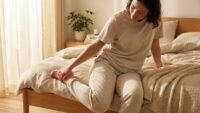
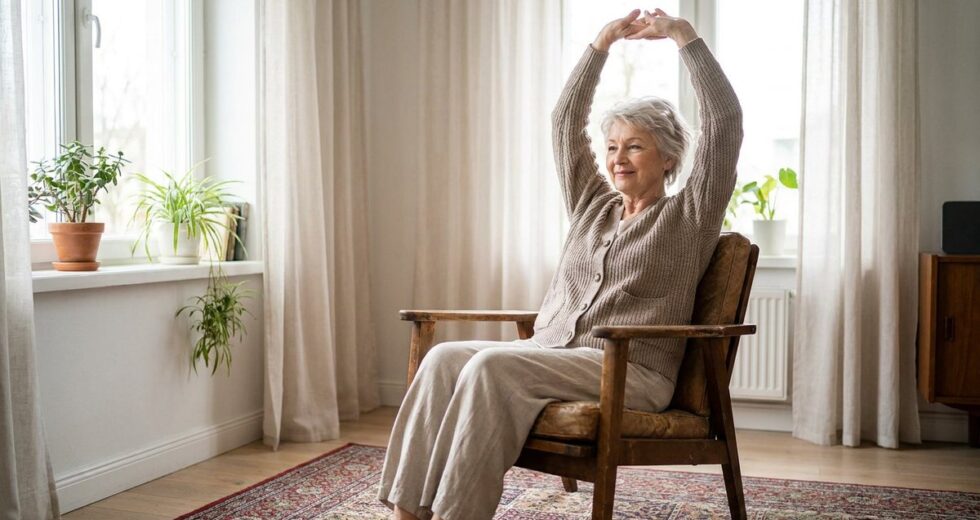
Chair yoga for seniors works best as a short seated sequence of breathing and gentle stretches, followed by a few supported standing moves if you are steady enough. The sequence below gives the hold, breaths and reps for every pose, plus a safety cue.
Seated yoga alone has thin evidence for balance. In a randomized trial of 131 older adults with leg osteoarthritis, 8 weeks of chair yoga reduced pain interference but did not change balance (Park et al., 2017, J Am Geriatr Soc). The standing options below exist for that reason.
Chair yoga sequence for seniors: poses, holds and reps
Use a sturdy chair without arms, with the back against a wall so it cannot slide. Sit near the front edge with your feet flat. The Dartmouth Health video below also calls for a sturdy chair without arms.
The holds and reps in the tables are conservative starting doses written for this article. The trials in the evidence section did not test these exact numbers. Stop for sharp pain, chest pain, dizziness or shortness of breath.
| Pose | How | Hold or reps | Safety cue |
|---|---|---|---|
| 1. Seated breathing | Sit tall with hands on your thighs. Breathe in through your nose and out slowly through your mouth. | 5 breaths | Keep your shoulders soft. If you feel lightheaded, return to normal breathing. |
| 2. Neck side stretch | Lower your right ear toward your right shoulder while the left shoulder stays down. | 3 breaths per side, 1 round | Move slowly. Skip backward neck rolls. |
| 3. Seated chest lift | Hold the sides of the seat, lengthen your spine and lift your breastbone slightly. | 3 breaths, 3 reps | Look straight ahead and do not round forward. |
| 4. Overhead reach | Raise both arms as you breathe in. Lower them as you breathe out. | 5 reps | If you feel dizzy or your arms tire, stop at shoulder height. |
| 5. Gentle seated twist | Hands on your thighs, turn your upper body a little to the right, then to the left. | 3 breaths per side, 2 rounds | Turn only as far as is easy and keep both hips on the seat. Skip it if you have osteoporosis unless your clinician approves. |
| 6. Side bend | Rest your right hand on the seat and reach your left arm up and over. | 3 breaths per side, 2 rounds | Lean without collapsing and keep both hips down. |
| 7. Seated march | Lift one knee, lower it, then switch. | 10 per leg | Hold the seat edge and keep your back upright. |
| 8. Leg extension | Straighten one knee, flex your foot, then lower slowly. | Hold 3 breaths, 5 reps per leg | Do not snap the knee straight. Ask your surgeon first if you have a knee replacement. |
| 9. Closing breath | Rest your hands on your belly and breathe slowly. | 5 breaths | Sit for a moment before you stand up. |
Supported standing options for balance
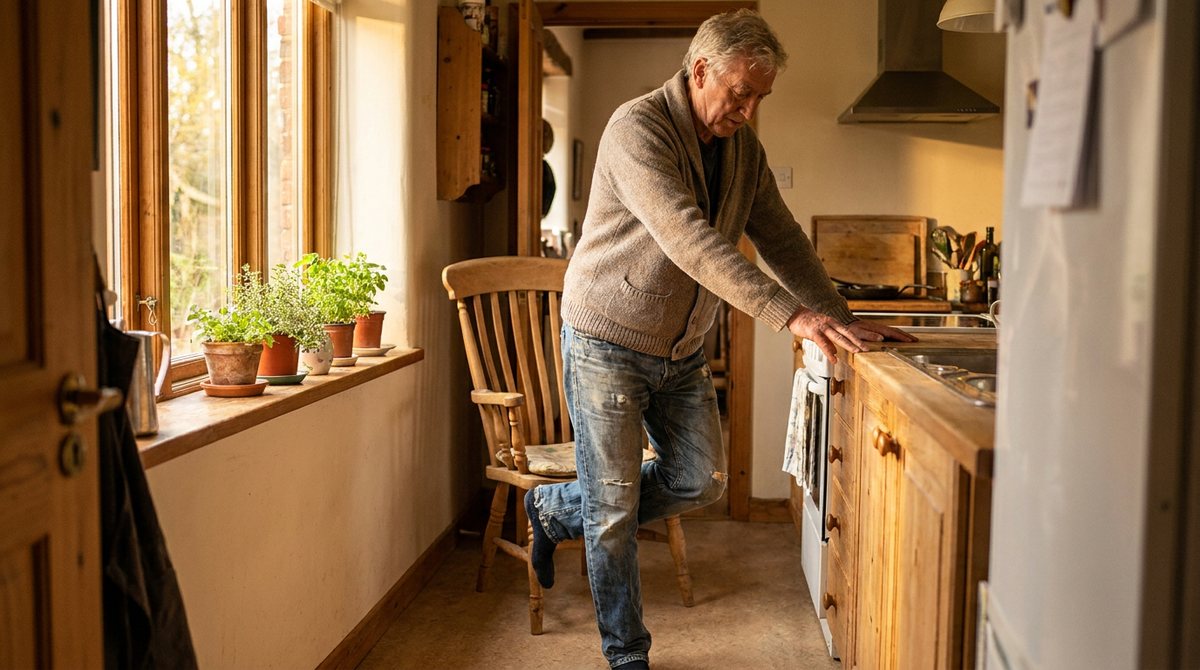
These four moves add the balance challenge that seated poses lack. Stand at a kitchen counter, with your chair close behind you. Rest your fingertips on the counter and use your whole hand only if you wobble.
| Move | How | Hold or reps | Safety cue |
|---|---|---|---|
| Sit-to-stand | Feet hip-width apart, lean forward from the hips and stand. Sit back down slowly over a count of 3. | 5 reps | Pause for one breath at the top before you step away. |
| Weight shifts | Shift your weight onto one foot, then the other. | 10 per side | Keep both feet down. |
| Supported single-leg stand | Lift one foot a few inches off the floor. | 5 breaths per side | Sit down at once if you lose control. |
| Heel raises | Rise onto your toes, then lower slowly. | 10 reps | Rise only as high as feels stable. |
CDC guidance for adults 65 and older lists balance activities such as standing up from a sitting position (CDC, Physical Activity Guidelines for Older Adults).
Does chair yoga help prevent falls? What the research says
| Study | Design | n | Result |
|---|---|---|---|
| Sherrington 2019, Cochrane Database Syst Rev | Systematic review of trials of any exercise | 108 trials, 23,407 participants | Exercise reduced the rate of falls by 23% (rate ratio 0.77, 95% CI 0.71 to 0.83; high-certainty evidence) |
| Sherrington 2017, Br J Sports Med | Meta-analysis of exercise trials | 88 trials, 19,478 participants | Falls down 21% overall. Programs that challenged balance and ran more than 3 hours a week cut falls by 39% |
| Youkhana 2016, Age Ageing | Meta-analysis of yoga-based exercise, ages 60 and over | 6 trials, 307 participants | Balance improved (Hedges’ g 0.40, 95% CI 0.15 to 0.65); mobility improved (g 0.50, 95% CI 0.06 to 0.95). Falls were not the outcome |
| Park 2017, J Am Geriatr Soc | Pilot randomized trial, chair yoga vs health education, 8 weeks | 131 randomized | Less pain interference (P = .01), sustained through 3 months. Gait speed improved (P = .024). No effect on balance |
| Galantino 2012, Int J Yoga | Single-arm pilot, 8 weeks, no control group | 16 seniors, median age 88, prior falls | No adverse events in sessions. Fear of falling score fell from 5.27 to 2.60 (P = 0.029) |
| Tew 2024, NIHR Open Res | Randomized trial, 12-week chair-based yoga plus usual care | 454 randomized | No significant difference in quality of life (adjusted difference 0.020, 95% CI -0.006 to 0.045). No serious related adverse events |
The Sherrington reviews cover exercise in general, not chair yoga.
Youkhana and colleagues say more research is needed to learn whether yoga balance gains translate to fewer falls. None of the chair yoga trials here measured falls as the main outcome.
My reading is that these trials show chair yoga is low-risk and may ease pain and mobility problems, while standing balance work carries the fall evidence.
How often should you do chair yoga?
Start with 3 sessions a week. The Park trial used twice-weekly 45-minute sessions for 8 weeks, and the Sherrington 2017 meta-analysis found its largest fall reductions with more than 3 hours of exercise a week.
The CDC asks adults 65 and older for 150 minutes of moderate aerobic activity a week, muscle strengthening on 2 or more days, and balance activities. A gentle seated sequence may not raise your breathing to a moderate level, so pair it with walking.
Our guides to Japanese walking and to lower-body strength exercises cover the other two pieces. Our overview of yoga for seniors covers the wider benefits.
Who should be careful with chair yoga
This is general information from a health writer, not a clinician. Talk to your doctor or physical therapist first if any of these apply:
- You have had a hip or knee replacement. Your surgeon sets limits on hip angle and leg crossing, and leg extensions need their approval.
- You have osteoporosis or a prior spine fracture. A Mayo Clinic case series described 9 people who developed vertebral compression fractures after yoga that involved spinal flexion (Sfeir et al., 2018). This sequence avoids forward folds and keeps twists small.
- You have glaucoma. A systematic review of case reports advises people with glaucoma to avoid inversions (Cramer et al., 2013, PLoS One). Keep your head above your heart.
- Your blood pressure is uncontrolled, or you get dizzy when you stand. Keep arm reaches at shoulder height and do the sit-to-stand only with a clinician’s approval.
- You had surgery recently, or you have an acute injury.
- You have a heart or lung condition that limits your everyday activity.
Chair yoga does not treat an acute injury, and it is not enough alone if you are at high risk of falling.
The 2020 abridged Cochrane review found a larger fall reduction in trials where a health professional, usually a physiotherapist, delivered the program (Sherrington et al., 2020, Br J Sports Med).
If you have fallen in the past year, ask for a physical therapist who can set up progressive standing balance and strength work.
Frequently asked questions
Is chair yoga good for seniors?
It looks safe and may help pain. In a 131-person trial, 8 weeks of chair yoga reduced pain interference in older adults with leg osteoarthritis (Park et al., 2017). A 454-person trial found no quality-of-life gain over usual care, but no serious related adverse events (Tew et al., 2024).
Can chair yoga improve balance?
Evidence is mixed. A meta-analysis of six yoga trials in people 60 and over found a small balance effect (Hedges’ g 0.40), but the Park chair yoga trial found no effect on balance. Adding supported standing moves gives your balance something to train.
How long should a chair yoga session be?
Start with the 9 seated poses above, then add the standing options when you feel steady. The Park trial ran 45-minute sessions twice a week for 8 weeks, and the Dartmouth Health video runs 15 minutes. Pick a length you can repeat.
Is chair yoga enough exercise for seniors?
No. CDC guidance for adults 65 and older asks for 150 minutes of moderate aerobic activity a week, muscle strengthening on 2 or more days, and balance activities. Chair yoga covers part of the balance and mobility piece, so add walking and strength work.
Does chair yoga prevent falls?
No chair yoga trial here shows it. The Cochrane review found exercise overall cut the rate of falls by 23% (Sherrington et al., 2019), but that covers many exercise types. The yoga meta-analysis says it is still unknown whether balance gains from yoga translate to fewer falls.
Sources
- Park J, McCaffrey R, Newman D, Liehr P, Ouslander JG. A Pilot Randomized Controlled Trial of the Effects of Chair Yoga on Pain and Physical Function Among Community-Dwelling Older Adults With Lower Extremity Osteoarthritis. J Am Geriatr Soc. 2017. PubMed.
- Sherrington C, et al. Exercise for preventing falls in older people living in the community. Cochrane Database Syst Rev. 2019. PubMed.
- Sherrington C, et al. Exercise to prevent falls in older adults: an updated systematic review and meta-analysis. Br J Sports Med. 2017. PubMed.
- Sherrington C, et al. Exercise for preventing falls in older people living in the community: an abridged Cochrane systematic review. Br J Sports Med. 2020. PubMed.
- Youkhana S, et al. Yoga-based exercise improves balance and mobility in people aged 60 and over: a systematic review and meta-analysis. Age Ageing. 2016. PubMed.
- Galantino ML, et al. Safety and feasibility of modified chair-yoga on functional outcome among elderly at risk for falls. Int J Yoga. 2012. PubMed.
- Tew G, et al. Effectiveness and cost-effectiveness of offering a chair-based yoga programme in addition to usual care in older adults with multiple long-term conditions. NIHR Open Res. 2024. PubMed.
- Sfeir JG, et al. Vertebral compression fractures associated with yoga: a case series. Eur J Phys Rehabil Med. 2018. PubMed.
- Cramer H, Krucoff C, Dobos G. Adverse events associated with yoga: a systematic review of published case reports and case series. PLoS One. 2013. PubMed.
- Centers for Disease Control and Prevention. Physical Activity Guidelines for Older Adults. cdc.gov.