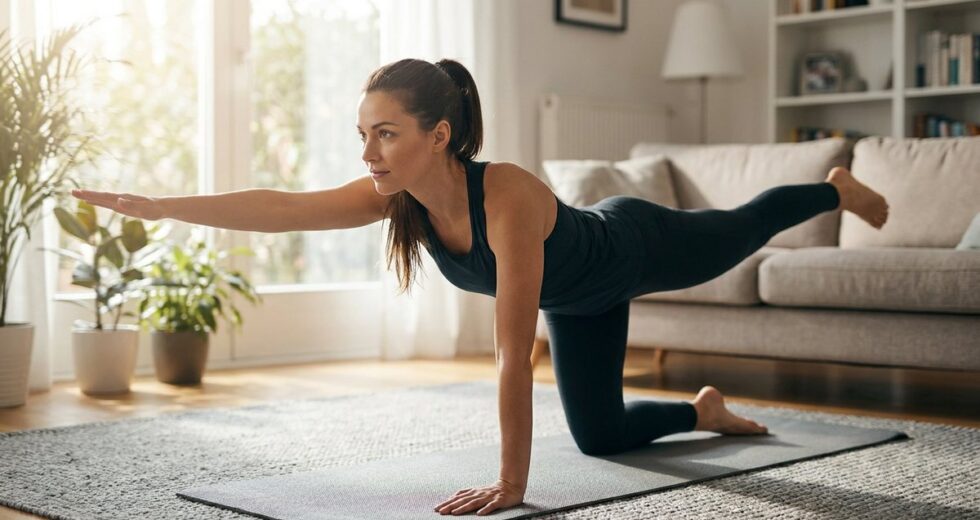
Walk on most days and add floor moves such as the pelvic tilt, bird dog and glute bridge on 3 days a week. No exercise type has proved clearly superior, so pick moves you will keep doing (Saragiotto et al., 2016, Cochrane).
The American College of Physicians lists exercise as a first-choice treatment for chronic low back pain (Qaseem et al., 2017). A review of 249 trials found it lowered pain 15.2 points on a 0 to 100 scale at earliest follow-up, versus no treatment, usual care or placebo (Hayden et al., 2021).
Does exercise help lower back pain? What the research found
| Study | Design | Result |
|---|---|---|
| Qaseem et al., 2017, Ann Intern Med | American College of Physicians guideline | Strong recommendation to start chronic pain care with nonpharmacologic options, including exercise (moderate-quality evidence) |
| Hayden et al., 2021, Cochrane | 249 trials, nonspecific pain lasting over 12 weeks | At earliest follow-up, pain 15.2 points lower than no treatment, usual care or placebo (moderate certainty); function 6.8 points better, below the review’s 10-point threshold |
| Saragiotto et al., 2016, Cochrane | 29 trials, 2,431 participants, motor control exercise | Not clinically more effective than other exercises; similar to manual therapy |
Against other conservative treatments, exercise lowered pain by 9.1 points and improved function by 4.1, and neither met the review’s threshold for a clinically important difference. It did no better than manual therapy (Hayden et al., 2021).
Most trials carried a risk of bias, and participants averaged 43.7 years old, so the evidence says less about adults in their 60s and 70s. Side effects were mostly minor, such as muscle soreness.
Yoga added risk too: adverse events, mainly more back pain, were higher than with no exercise at 6 to 12 months (43 versus 9 per 1,000), though similar to other exercise (low-certainty evidence; Wieland et al., 2022).
If floor work is hard, our chair yoga sequence has seated poses, though it was not built for back pain.
New pain or old pain: where to start
Most acute or subacute low back pain improves over time regardless of treatment. For it, the American College of Physicians lists heat, massage, acupuncture and spinal manipulation, with exercise in its chronic pain list (Qaseem et al., 2017).
Many guidelines advise resuming normal activities and exercise (Foster et al., 2018, Lancet). In the first weeks, start with short walks and the gentlest moves below, adding strength work as pain eases.
Lower back pain exercises: a 6-week starter plan
The holds, reps, sets, walking times and schedule below were written for this article as a cautious starting point. No trial tested them.
| Exercise | How to do it | Dose per set |
|---|---|---|
| Pelvic tilt | On your back, knees bent. Flatten your lower back toward the floor, hold, then release. | 5-second hold, 8 reps |
| Single knee to chest | On your back, pull one knee toward your chest with both hands. | 20-second hold, 2 per side |
| Cat-camel | On hands and knees, slowly round your back, then arch gently. Keep the range small. | 8 slow reps |
| Glute bridge | On your back, knees bent. Lift your hips until shoulders, hips and knees line up. | 5-second hold, 8 reps |
| Bird dog | On hands and knees, extend one arm and the opposite leg level with your back. | 5-second hold, 4 per side |
| Curl-up | On your back, one knee bent, hands under your lower back. Lift your head and shoulders slightly. | 5-second hold, 4 reps |
| Side plank, knees bent | On your side, forearm under your shoulder, lift your hips into a straight line. | 10-second hold, 2 per side |
| Hip hinge | Standing, hands on hips. Push your hips back with a flat back, then stand tall. | 8 reps |
Walk on 5 days a week and do the floor moves on 3 non-consecutive days.
| Weeks | Walking | Floor moves |
|---|---|---|
| 1 and 2 | 10 minutes | Pelvic tilt, knee to chest, cat-camel, 1 set each |
| 3 and 4 | 15 minutes | Add glute bridge and bird dog, 1 set each; raise pelvic tilt and cat-camel to 2 sets |
| 5 and 6 | 20 minutes | Add curl-up, side plank and hip hinge, 1 set each; raise glute bridge and bird dog to 2 sets |

Our somatic exercises sequence has a similar arch-and-flatten if you want a slower warm-up, though the evidence for somatic work is thin. The Hospital for Special Surgery video below shows the single knee to chest.
How hard to push
Pain during exercise need not block progress. In a meta-analysis of seven trials in chronic musculoskeletal pain, exercise that allowed pain beat pain-free exercise in the short term (effect size 0.27), with no difference later (Smith et al., 2017, Br J Sports Med).
As a practical rule without trial support, keep discomfort mild and settled by the next day. Stop if pain turns sharp or spreads into a leg. The NHS also advises stopping if pain gets worse and seeing a GP.
Is walking good for lower back pain?
Walking compares well with other exercise. In a meta-analysis of 5 trials, walking and other exercise improved pain, disability and quality of life similarly (Vanti et al., 2019, Disabil Rehabil).
In the WalkBack trial, 701 adults recently recovered from low back pain were randomized to progressive walking and education, with six physiotherapist sessions over 6 months, or to no treatment. Median time to an activity-limiting recurrence was 208 days versus 112 (hazard ratio 0.72; Pocovi et al., 2024, Lancet).
The walking group had more lower-limb adverse events (100 versus 54), though the share of people with any adverse event was similar (52% versus 54%). Add minutes gradually.
Once easy walking feels fine, our guide to Japanese interval walking explains a structured format and who should check with a clinician first.
Who should be careful and when to see a clinician
Serious causes are uncommon. Among 1,172 people seeing a primary care clinician in Sydney for acute low back pain, 11 (0.9%) had serious pathology, and 8 of those were fractures (Henschke et al., 2009, Arthritis Rheum).
Still, get checked before starting this plan if your back pain comes with any of these (NIAMS; NHS; Downie et al., 2013, BMJ):
- new trouble urinating or controlling your bowels
- numbness around your genitals or anus
- weakness, numbness or tingling in one or both legs
- fever, or feeling hot, shivery or unwell
- pain that began after a fall or other significant injury
- weight loss you did not intend, or a history of cancer
- long-term steroid use
- pain that has not improved after a few weeks
A review of 105 articles proposed defining cauda equina syndrome by bladder or bowel dysfunction, reduced saddle-area sensation or sexual dysfunction (Fraser et al., 2009).
The NHS says to call 999 or go to A&E for those symptoms, for pain, tingling, weakness or numbness in both legs, and after a serious accident. In the US, call 911 or go to an emergency room. Do not exercise through any of them.
Treat a red flag as a reason to ask a clinician. A BMJ review found many guideline red flags barely change the probability of fracture or cancer, though a history of cancer and prolonged corticosteroid use were among the more informative (Downie et al., 2013).
Exercise cannot replace a diagnosis. The American College of Physicians and American Pain Society guideline calls for imaging and testing when neurologic deficits are severe or progressive, or when a serious underlying condition is suspected (Chou et al., 2007, Ann Intern Med).
Ask first if you have osteoporosis or a spine fracture. A Mayo Clinic case series described 9 people, median age 66, who developed vertebral compression fractures after starting yoga-associated spinal flexion exercises (Sfeir et al., 2018).
A consensus panel recommended multicomponent resistance and balance training for osteoporosis, called its recommendations conditional and said there is too little evidence to quantify the risks (Giangregorio et al., 2014).
With osteoporosis or a spine fracture, skip knee to chest, curl-up and the rounding half of cat-camel until your clinician approves, because they bend the spine forward.
Frequently asked questions
What is the best exercise for lower back pain?
No single exercise has proved best. Motor control exercise was no better than other exercise (Saragiotto et al., 2016), and walking and other exercise improved pain similarly (Vanti et al., 2019). Walk most days and add the pelvic tilt, bird dog and glute bridge.
How often should I do exercises for lower back pain?
The plan above uses walking on 5 days a week and floor moves on 3 non-consecutive days. No trial tested that exact schedule, so treat it as a cautious starting point. Slow down if your pain is still higher the next day.
Should I exercise through back pain?
Mild discomfort that settles by the next day is a reasonable rule of thumb, though no trial tested it. In seven trials of chronic musculoskeletal pain, painful exercise beat pain-free exercise in the short term only (Smith et al., 2017). Stop if pain turns sharp, spreads into a leg or worsens, and see a clinician.
Does yoga help lower back pain?
It helps only slightly. Versus no exercise, pain was 4.5 points lower at 3 months on a 0 to 100 scale, below the review’s 15-point threshold, and adverse events, mainly more back pain, were higher at 6 to 12 months (Wieland et al., 2022). Function was similar to other back-focused exercise.
When should I see a doctor about lower back pain?
See one if pain has not improved after a few weeks, or if it comes with leg weakness, fever, unintended weight loss or pain after a fall (NIAMS; NHS). Bladder or bowel changes, numbness around your genitals, or weakness or numbness in both legs need emergency care.
Sources
- Qaseem A, et al. Ann Intern Med. 2017. PubMed 28192789
- Hayden JA, et al. Cochrane Database Syst Rev. 2021. PubMed 34580864
- Saragiotto BT, et al. Cochrane Database Syst Rev. 2016. PubMed 26742533
- Wieland LS, et al. Cochrane Database Syst Rev. 2022. PubMed 36398843
- Vanti C, et al. Disabil Rehabil. 2019. PubMed 29207885
- Pocovi NC, et al. Lancet. 2024. PubMed 38908392
- Foster NE, et al. Lancet. 2018. PubMed 29573872
- Smith BE, et al. Br J Sports Med. 2017. PubMed 28596288
- Henschke N, et al. Arthritis Rheum. 2009. PubMed 19790051
- Downie A, et al. BMJ. 2013. PubMed 24335669
- Fraser S, et al. Arch Phys Med Rehabil. 2009. PubMed 19887225
- Chou R, et al. Ann Intern Med. 2007. PubMed 17909209
- Sfeir JG, et al. Eur J Phys Rehabil Med. 2018. PubMed 29687967
- Giangregorio LM, et al. Osteoporos Int. 2014. PubMed 24281053
- NIAMS. Back Pain Symptoms, Types, and Causes.
- NHS. Back pain.
- Hospital for Special Surgery. Single Knee to Chest Exercise (video).