
Balance exercises for seniors work best as a four-level progression: hold a counter with both hands, then fingertips, then no hands, then add walking. Move up when you can hold a position for 10 seconds, the yardstick the CDC uses in its 4-Stage Balance Test.
A Cochrane review of 108 trials found that exercise cuts the rate of falls by 23% in older adults living at home (Sherrington et al., 2019, Cochrane). Below are the holds, reps and weekly schedule for each level, plus three CDC STEADI self-checks.
Why balance training lowers fall risk
In 2018, 27.5% of community-dwelling US adults 65 and older reported a fall in the past year, and 10.2% reported a fall-related injury (US Preventive Services Task Force, JAMA, 2024). The task force recommends exercise for those at increased risk and rates the net benefit as moderate.
The type of exercise matters. In a 2017 meta-analysis of 88 trials, programs that challenged balance and ran more than 3 hours a week produced a 39% reduction in falls (Sherrington et al., 2017, British Journal of Sports Medicine).
A 15-minute routine will not reach that dose alone, so treat this plan as the balance core of a bigger week.
What the research found
| Study | Design | Result |
|---|---|---|
| Sherrington et al., 2019, Cochrane | 108 trials, 23,407 participants | Exercise cut fall rate 23% (rate ratio 0.77) |
| Sherrington et al., 2020, Br J Sports Med | Abridged Cochrane update | Balance and functional exercises cut falls 24%; multiple exercise types 34% |
| Sherrington et al., 2017, Br J Sports Med | 88 trials, 19,478 participants | Balance-challenging programs over 3 hours a week: 39% fewer falls |
| Thomas et al., 2010, Age and Ageing | 7 Otago exercise programme trials, 1,503 participants | Fall rate ratio 0.68 |
| Li et al., 2018, JAMA Internal Medicine | 670 adults 70 and older at high fall risk, 24 weeks | Tai ji quan beat stretching on falls (rate ratio 0.42) |
Check your starting point with CDC STEADI tests
STEADI stands for Stopping Elderly Accidents, Deaths and Injuries, the CDC toolkit clinicians use to screen fall risk. Its three sheets use a stopwatch and a chair, with a person standing next to the patient for safety. Do not test yourself alone if you feel unsteady.
30-Second Chair Stand
Sit in a straight-backed chair without arms, about 17 inches high, with arms crossed over your chest and feet flat. Stand fully and sit back down as many times as you can in 30 seconds. If you must use your hands, the CDC scores it as zero.
A score below the number for your age and sex signals fall risk.
| Age | Men: below average if under | Women: below average if under |
|---|---|---|
| 60 to 64 | 14 | 12 |
| 65 to 69 | 12 | 11 |
| 70 to 74 | 12 | 10 |
| 75 to 79 | 11 | 10 |
| 80 to 84 | 10 | 9 |
| 85 to 89 | 8 | 8 |
| 90 to 94 | 7 | 4 |
4-Stage Balance Test
Hold each position for 10 seconds, eyes open, no cane or walker: feet side by side, then the instep of one foot touching the big toe of the other, then tandem (one foot in front, heel touching toe), then one foot.
If you cannot hold a position for 10 seconds, stop there. The CDC says anyone who cannot hold the tandem stand for 10 seconds is at increased risk of falling, and suggests physical therapy or an evidence-based program such as Tai Chi.
Timed Up and Go
Sit in an armchair, stand, walk 10 feet at your normal pace, turn, walk back and sit. Time it from “Go” until you are seated. The CDC says 12 seconds or more indicates risk of falling.
Wear your usual shoes and use your regular walking aid if you have one.
Balance exercises for seniors: the four-level progression
If you could not hold the side-by-side stand for 10 seconds, begin at Level 1. If you passed tandem but not one-foot, begin at Level 2 or 3.
The holds and reps below are a cautious starting design built around the CDC 10-second yardstick. No trial tested this exact dose, and the trials above used supervised, progressive programs.
| Level | Support | Exercises | Hold or reps | Move up when |
|---|---|---|---|---|
| 1 | Both hands on a counter | Feet-together stand, heel raises, side leg lifts | 10 seconds, 2 sets; 8 reps per side | You hold 10 seconds with hands barely pressing |
| 2 | Fingertips on a counter | Semi-tandem, tandem and single-leg stands | 10 seconds per side, 3 tries | You hold 10 seconds with fingertips lifted |
| 3 | No hands, counter within reach | Tandem and single-leg stands, standing on a folded towel | 10 seconds per side, 3 tries | You hold 10 seconds three times without touching |
| 4 | Dynamic, wall nearby | Heel-to-toe walking, sidestepping, slow turns, chair stands without hands | 10 steps, 3 passes; 8 chair stands | You walk heel-to-toe without sidestepping to recover |
Level 1: counter-supported
Stand tall at a kitchen counter, feet hip-width, both hands resting on the surface. Shift your weight slowly from one foot to the other, then try the feet-together stand. Add heel raises and side leg lifts, and keep a chair behind you.
Level 2: fingertips only
Rest two or three fingertips on the counter and work through the first three positions of the 4-Stage test. When tandem feels steady, lift one foot an inch or two off the floor and hold. Switch sides.
Level 3: hands-free
Stand an arm’s length from the counter with your hands at your sides. Your arms may drift out to help, which the CDC test allows as long as your feet do not move.
For a harder surface, stand on a folded bath towel once the floor version feels easy.
Level 4: dynamic balance
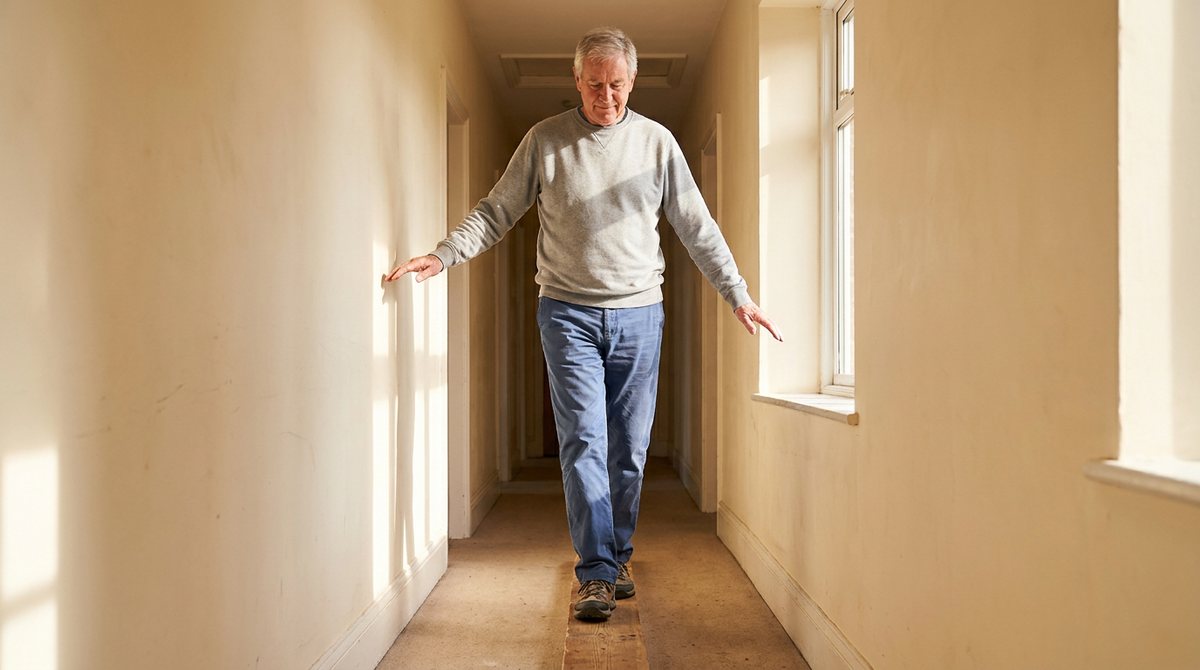
The final level adds movement: walk heel-to-toe along a hallway, fingertips near the wall if needed. The National Institute on Aging video below demonstrates the balance walk. Then add sidesteps, slow turns and hands-free chair stands.
How often to practice and how to progress
As a practical suggestion rather than a trial protocol, start with three non-consecutive days a week for 15 minutes. Stay at a level for at least two weeks before moving up.
Add walking on the other days. Our guide to Japanese interval walking gives a structured way to build that base.
Retest the Chair Stand and the 4-Stage Balance Test every four weeks and write the numbers down. If your chair stand count sits below the CDC cutoff, our guide to how much protein per day covers the nutrition side of strength.
If you cannot yet stand without support, a seated routine such as chair yoga for seniors is a gentler place to start before Level 1.
Who should be careful and when exercise is not enough
Check in with a doctor or physical therapist before starting if you have had a recent fall, feel dizzy when you stand up, or take medicines that make you drowsy. Exercise does not fix every cause of unsteadiness.
Positional vertigo (BPPV) is one clear case. In a Cochrane review of Epley maneuver trials, vertigo resolved in 56% of treated people versus 21% with sham or no treatment (Hilton and Pinder, 2014, Cochrane Database of Systematic Reviews).
Standing drills do not replace that treatment, which a clinician performs.
Vision loss is another gap. A 2020 Cochrane review of six trials found no evidence of effect for most environmental or behavioral interventions in visually impaired older people, with low-certainty evidence. If you have vision loss, ask for a plan tailored to you.
The CDC Timed Up and Go sheet lists shuffling, short strides, little arm swing and en bloc turning, and says these may signify neurological problems that require further evaluation. Numbness in your feet or a sudden change in how you walk deserves a medical visit first.
Clinician-led programs may work better. The 2020 Cochrane summary found a larger effect when a health professional, usually a physiotherapist, delivered the exercise.
Stop if you feel sharp pain, chest discomfort or light-headedness, and tell your clinician.
Where tai chi fits
Once Level 4 feels comfortable, a tai chi class is a practical next step.
In an Oregon trial of 670 adults 70 and older at high risk, two 60-minute tai ji quan classes a week for 24 weeks lowered falls more than stretching (rate ratio 0.42). Falls were 31% lower than with a multimodal exercise program (Li et al., 2018).
The lead author reported a licensing fee for the tai ji quan program, so weigh the result with that in mind. The 2020 Cochrane summary rated tai chi’s effect at 19% fewer falls, with low-certainty evidence.
Frequently asked questions
What is the best balance exercise for seniors?
No single move wins. A 2017 meta-analysis found that programs challenging balance, totaling more than 3 hours a week, had the largest effect on falls. A progression from supported stands to tandem, single-leg and heel-to-toe walking follows that principle and is easy to scale up.
How often should seniors do balance exercises?
This plan starts with three non-consecutive days a week, 15 minutes each. Trials with the biggest fall reductions totaled more than 3 hours of exercise weekly, so add walking and strength work on the other days rather than stretching one routine.
How long should a senior be able to stand on one leg?
In the CDC 4-Stage Balance Test the target for each stance is 10 seconds, eyes open and no support. The CDC flags an inability to hold the tandem stand for 10 seconds as increased fall risk. The one-foot stand is the fourth and hardest position.
Can balance exercises be done every day?
The plan above schedules rest days so you can judge progress and let tired muscles recover. If you have joint pain, dizziness or a recent fall, ask your clinician before adding daily sessions or moving to a harder level than your test results support.
When should I see a doctor about my balance?
See a clinician if you score below the CDC cutoff on the chair stand, take 12 seconds or more on Timed Up and Go, cannot hold tandem for 10 seconds, or have dizziness, numbness or a recent fall. The CDC suggests physical therapy for these results.
Sources
- Sherrington C, et al. Cochrane Database Syst Rev. 2019. PubMed 30703272
- Sherrington C, et al. Br J Sports Med. 2017. PubMed 27707740
- Sherrington C, et al. Br J Sports Med. 2020. PubMed 31792067
- US Preventive Services Task Force. JAMA. 2024. PubMed 38833246
- Thomas S, et al. Age Ageing. 2010. PubMed 20817938
- Li F, et al. JAMA Intern Med. 2018. PubMed 30208396
- Hilton MP, Pinder DK. Cochrane Database Syst Rev. 2014. PubMed 25485940
- E JY, et al. Cochrane Database Syst Rev. 2020. PubMed 32885841
- CDC STEADI: 30-Second Chair Stand, 4-Stage Balance Test, Timed Up and Go, 2017.
- National Institute on Aging. Balance Exercise for Older Adults (video).