Most healthy adults need at least 0.8 grams of protein per kilogram of body weight per day, which is 0.36 grams per pound. Older adults, people who lift weights and people recovering from illness are usually better served by 1.0 to 1.6 grams per kilogram.
The gap between the minimum and a useful target is large, so the number on a label can mislead you. This article gives you the calculation, the evidence behind each range, sample foods with their protein content, and the situations where you should check with a clinician first.
How much protein per day do you need by body weight?
The adult Recommended Dietary Allowance (RDA) for protein is 0.8 g/kg and has been essentially unchanged for more than 70 years. It was set as the minimum needed to avoid losing body nitrogen, not as the amount that maximizes health (Wolfe et al., 2017, Advances in Nutrition).
Divide your weight in pounds by 2.2 to get kilograms, then multiply by the grams-per-kilogram figure that fits your situation. The table does the math for five common body weights.
| Body weight | RDA minimum (0.8 g/kg) | Older adult or active (1.2 g/kg) | Lifting weights (1.6 g/kg) |
|---|---|---|---|
| 130 lb (59 kg) | 47 g | 71 g | 94 g |
| 150 lb (68 kg) | 54 g | 82 g | 109 g |
| 170 lb (77 kg) | 62 g | 92 g | 123 g |
| 190 lb (86 kg) | 69 g | 103 g | 138 g |
| 210 lb (95 kg) | 76 g | 114 g | 152 g |
Figures are rounded to the nearest gram. Use your current weight unless you carry a lot of excess body fat, in which case a registered dietitian can help you pick a reference weight.
How much protein do you need as you get older?
After 65, you need more per kilogram than a younger adult, not less. The PROT-AGE Study Group recommends at least 1.0 to 1.2 g/kg a day for older people, and at least 1.2 g/kg for those who exercise (Bauer et al., 2013, J Am Med Dir Assoc).
The group’s reasoning is that older bodies respond less to ingested protein and face more inflammatory and catabolic stress from disease. It advises 1.2 to 1.5 g/kg for most older adults with acute or chronic illness.
The ESPEN expert group reached nearly identical numbers: at least 1.0 to 1.2 g/kg for healthy older people and 1.2 to 1.5 g/kg for those who are malnourished or at risk because of illness (Deutz et al., 2014, Clin Nutr).
Protein works best alongside movement. If you are building a routine, our chair yoga for seniors sequence is a low-impact place to start.
How much protein do you need to build muscle?
For lifters, 1.4 to 2.0 g/kg a day is enough for most people, according to the International Society of Sports Nutrition position stand (Jäger et al., 2017, J Int Soc Sports Nutr).
A meta-analysis of 49 trials with 1,863 participants found that gains in fat-free mass stopped increasing beyond about 1.62 g/kg a day. The benefit of supplementing also shrank with age and was larger in people who were already resistance-trained (Morton et al., 2018, Br J Sports Med).
So 2.5 g/kg is not a better muscle plan than 1.6 g/kg. Spend the extra effort on a better training program, such as the progressive overload schedule for beginners.
What does the evidence say, and how strong is it?
The table lines up each source with what it found. The industry ties listed after it affect how hard you should lean on any single paper.
| Source | Type | Finding |
|---|---|---|
| Wolfe 2017 | Review | The adult RDA of 0.8 g/kg is a floor set to avoid nitrogen loss |
| Phillips 2016 | Review | At least 1.2 to 1.6 g/kg is a better target for adults, with no evidence-based link to kidney disease or poor bone health in healthy people |
| Bauer 2013 | Expert position paper | 1.0 to 1.2 g/kg over 65, at least 1.2 g/kg if active, 1.2 to 1.5 g/kg with disease |
| Deutz 2014 | Expert recommendations | 1.0 to 1.2 g/kg for healthy older adults, 1.2 to 1.5 g/kg at nutritional risk |
| Morton 2018 | Meta-analysis, 49 trials | No extra fat-free mass gain beyond about 1.62 g/kg |
| Jäger 2017 | Position stand | 1.4 to 2.0 g/kg is sufficient for most exercising people |
Several authors report industry funding. Wolfe lists beef industry grants and a co-author works for the National Cattlemen’s Beef Association. The Morton analysis discloses that its senior author, Phillips, has received grant support and honoraria from the US National Dairy Council, which also supported trials in that analysis.
The ranges still agree with independent expert groups such as PROT-AGE and ESPEN. The 1.2 to 1.6 g/kg target from Phillips comes from a review of conference presentations, not a trial that tested health outcomes at each dose, so treat it as a reasonable range and not a proven optimum.
What does 100 grams of protein look like in food?
These values come from the USDA FoodData Central SR Legacy database and are per 100 grams of the food as listed. A typical serving is often 85 to 150 grams, so scale up or down.
| Food (100 g) | Protein |
|---|---|
| Chicken breast, roasted, meat only | 31.0 g |
| Ground beef, 90% lean, broiled | 26.1 g |
| Atlantic salmon, farmed, cooked | 22.1 g |
| Almonds | 21.2 g |
| Firm tofu, calcium sulfate | 17.3 g |
| Egg, hard-boiled | 12.6 g |
| Cottage cheese, 2% fat | 10.5 g |
| Greek yogurt, plain, nonfat | 10.2 g |
| Lentils, boiled | 9.0 g |
| Black beans, boiled | 8.9 g |

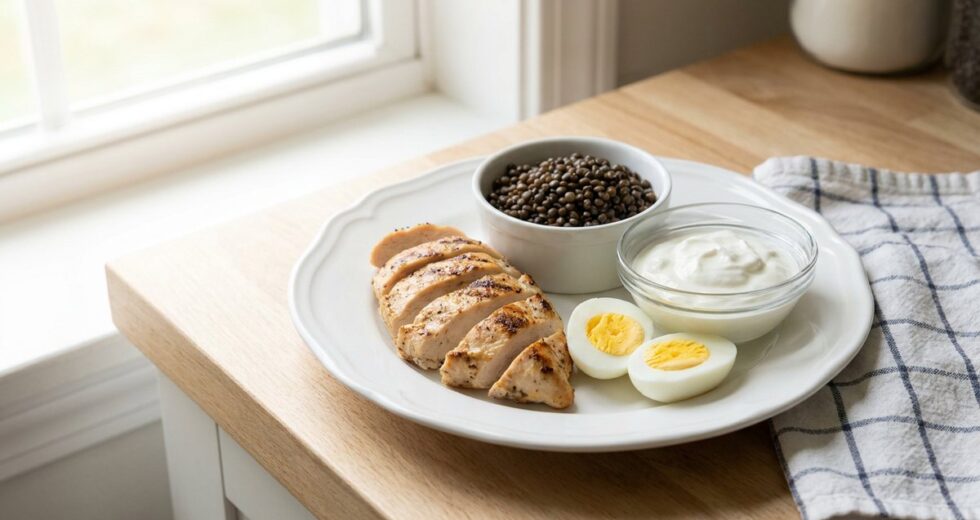
Here is a sample day built from those foods. It reaches about 90 g, or roughly 1.3 g/kg for a 150 lb adult, before counting the protein in bread, rice or vegetables.
| Meal | Foods | Protein |
|---|---|---|
| Breakfast | 200 g Greek yogurt with 30 g almonds | 26.7 g |
| Lunch | 150 g lentils with 100 g hard-boiled egg | 26.1 g |
| Snack | 100 g cottage cheese | 10.5 g |
| Dinner | 120 g salmon with vegetables | 26.5 g |
Spreading protein across meals is common advice, but the PROT-AGE group says evidence on timing and protein quality is not yet strong enough for specific recommendations. Hitting your daily total matters more than splitting it perfectly.
Who should be careful with a higher protein intake?
If you have chronic kidney disease, do not raise your protein on your own. High intake may increase pressure inside the kidney’s filters, and a low-protein diet of 0.6 to 0.8 g/kg a day is often recommended in CKD management (Ko et al., 2017, Curr Opin Clin Nutr Metab Care).
The PROT-AGE paper names older adults with severe kidney disease (eGFR below 30 mL/min/1.73 m2) who are not on dialysis as an exception to its higher targets. They may need to limit protein.
In healthy adults, Phillips and colleagues found no evidence-based link between higher protein diets and renal disease. If you do not know your kidney function, a routine blood test can tell your clinician before you change your diet.
A higher target may also not fit you for other reasons. Check with a clinician or registered dietitian if you are pregnant, have liver disease, have a metabolic disorder such as phenylketonuria, or take medicines that affect kidney function.
The video below, from a registered dietitian at Stanford Health Care, covers protein for people with chronic kidney disease, including plant sources such as beans, lentils and tofu.
Extra protein will not offset a diet that is short on calories or fiber. If your goal is fat loss, our guide to reducing visceral fat covers where protein fits.
Frequently asked questions
Is 0.8 g/kg enough protein for most people?
It is enough to avoid losing body nitrogen in most healthy adults, which is how the RDA was set. A 2016 review by Phillips and colleagues suggests 1.2 to 1.6 g/kg for better health outcomes, and expert groups advise more with age or exercise. Your needs depend on activity, age and health conditions.
Can you eat too much protein?
A 2016 review found no evidence-based link between higher protein diets and kidney disease in healthy adults. People with chronic kidney disease are different and may need to limit protein. If you are unsure about your kidney function, ask your clinician before raising your intake.
How much protein do you need to lose weight?
A review by Phillips and colleagues reports that higher protein diets improve satiety and lead to greater reductions in body weight and fat mass than standard protein diets. Their suggested target for adults is at least 1.2 to 1.6 g/kg a day, adjusted by your clinician if you have kidney problems.
Do you need protein powder to hit your target?
No. The sample day above reaches about 90 g from whole foods, so powder is a convenience and not a requirement. In the Morton meta-analysis, supplementation helped lifters gain strength, but total protein beyond about 1.62 g/kg a day added no further fat-free mass.
Does protein timing matter?
Less than the daily total does. The PROT-AGE group says evidence on timing is not yet sufficient for specific recommendations. For lifters, the sports nutrition position stand notes that protein before or after resistance exercise is synergistic, so eating protein near a workout is a reasonable habit.
Sources
- Wolfe RR, Cifelli AM, Kostas G, Kim IY. Optimizing protein intake in adults: interpretation and application of the Recommended Dietary Allowance compared with the Acceptable Macronutrient Distribution Range. Adv Nutr. 2017. PubMed.
- Bauer J, et al. Evidence-based recommendations for optimal dietary protein intake in older people: a position paper from the PROT-AGE Study Group. J Am Med Dir Assoc. 2013. PubMed.
- Deutz NE, et al. Protein intake and exercise for optimal muscle function with aging: recommendations from the ESPEN Expert Group. Clin Nutr. 2014. PubMed.
- Morton RW, et al. A systematic review, meta-analysis and meta-regression of the effect of protein supplementation on resistance training-induced gains in muscle mass and strength in healthy adults. Br J Sports Med. 2018. PubMed.
- Jäger R, et al. International Society of Sports Nutrition position stand: protein and exercise. J Int Soc Sports Nutr. 2017. PubMed.
- Phillips SM, Chevalier S, Leidy HJ. Protein “requirements” beyond the RDA: implications for optimizing health. Appl Physiol Nutr Metab. 2016. PubMed.
- Ko GJ, Obi Y, Tortorici AR, Kalantar-Zadeh K. Dietary protein intake and chronic kidney disease. Curr Opin Clin Nutr Metab Care. 2017. PubMed.
- U.S. Department of Agriculture. FoodData Central, SR Legacy dataset (April 2018). fdc.nal.usda.gov.