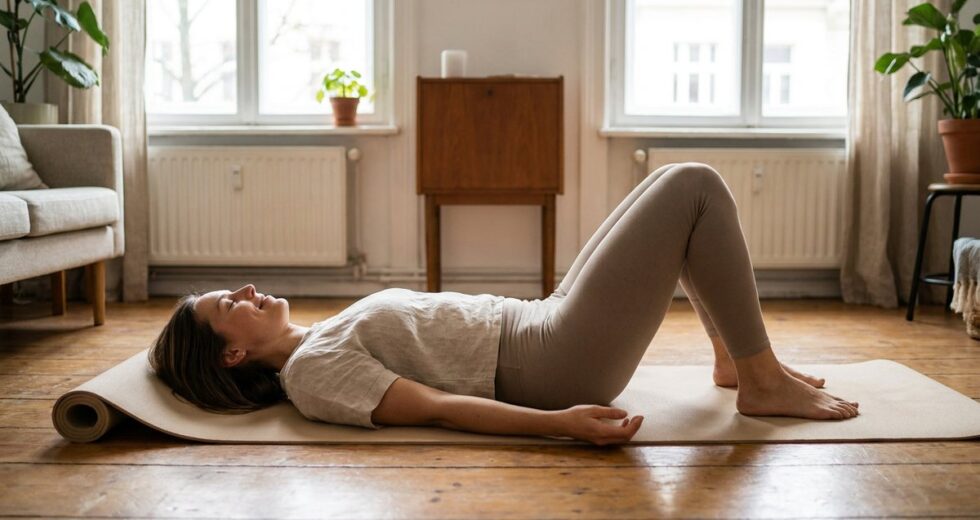
Somatic exercises are slow, deliberate movements you do with your attention on how the movement feels, rather than on how far or hard you can push. Short home routines need only a mat or a firm bed.
The evidence is thin. The best data come from small, uncontrolled studies, so treat somatic exercises as a gentle movement practice and not a proven treatment. Below you get a beginner sequence, what the research does and does not show, and who should see a clinician first.
What are somatic exercises?
Hanna somatic education (HSE) is described in the medical literature as a method of neuromuscular, mind-body movement retraining that is used to help manage pain (Huang and Babgi, 2022, Saudi J Med Med Sci).
You will often meet the term pandiculation in somatic circles. It means the involuntary stretching that occurs in most animal species around sleep and waking. A 2011 paper proposed that pandiculation might help maintain the myofascial system, but it was a hypothesis built from clinical observation, not a trial (Bertolucci, 2011, J Bodyw Mov Ther).
Related approaches exist. Johns Hopkins Medicine publishes a somatic movement video series, and the session embedded later in this article is rooted in the Feldenkrais Method.
A beginner somatic exercise sequence
Lie on a firm surface with your knees bent and feet flat. Move at about half the speed that feels natural, and stop when you feel any sharp pain, numbness or tingling.
The reps and times below are conservative starting doses written for this article. The studies in the evidence section did not test these exact numbers.
| Move | How | Reps or time | Cue |
|---|---|---|---|
| 1. Arch and flatten | Slowly tilt your pelvis so your lower back arches slightly, then press it gently toward the floor. | 5 reps, 5 seconds each direction | Keep your breath moving. Make the arch small. |
| 2. Pelvic clock | Imagine a clock on your lower belly. Tilt toward 12, then 3, 6 and 9. | 2 rounds each way | Notice which direction feels stiff, then go gently. |
| 3. Knee drop | Let both knees fall slowly to one side, then return and switch. | 5 per side | Keep your shoulders on the floor. Stay in a comfortable range. |
| 4. Slow head turn | Turn your head to one side as slowly as you can, pause, then return. | 5 per side | Stop before any pinch or dizziness. |
| 5. Arm slide | Slide one arm along the floor above your head, then back down. | 5 per arm | Let your ribs stay soft. Skip it if your shoulder hurts. |
| 6. Standing weight shift | Stand near a counter and shift weight slowly from one foot to the other. | 10 shifts | Rest your fingertips on the counter if you wobble. |
Try the sequence once a day for a week and notice how your back, neck and hips feel before and after. Keep a short note so you can compare.
Do somatic exercises work? What the studies found
Only one clinical study of Hanna somatic education turned up in a PubMed search run for this article in October 2026. It was a retrospective review of 103 patients with neck or low back pain lasting more than two months, who received an average of 2.8 sessions (Huang and Babgi, 2022).
Pain levels fell significantly between the first and last visits (P below 0.001). The number of patients using pain medication dropped from 53 to 14, and mean doctor visits fell from 2 to 0.5 over six months.
There was no control group, so natural improvement, placebo effects and other care cannot be separated out. The authors themselves recommend further investigation.
The closest higher-quality evidence is for Feldenkrais, a related method. A systematic review of 16 studies found that in three trials in chronic low back pain it improved pain, disability, quality of life and interoceptive awareness, with effects comparable to other physiotherapy techniques in spine pain (Berland et al., 2022, Int J Environ Res Public Health).
| Source | Design | Finding |
|---|---|---|
| Huang 2022 | Retrospective, 103 patients, no control group | Lower pain, fewer medication users and doctor visits after HSE |
| Berland 2022 | Systematic review of Feldenkrais, 16 studies | Better pain and disability in 3 low back pain trials; Timed Up and Go improved in older adults (Cohen’s d -1.14) |
| Hayden 2021 | Cochrane review, 249 trials of exercise for chronic low back pain | Exercise lowers pain versus no treatment (MD -15.2, moderate certainty); no difference versus manual therapy |
| Bertolucci 2011 | Hypothesis paper | Proposes a role for pandiculation in the myofascial system; not a trial |
How do somatic exercises compare with ordinary exercise for back pain?
Ordinary exercise has far more evidence behind it. A Cochrane review of 249 trials found moderate-certainty evidence that exercise reduces chronic low back pain compared with no treatment, usual care or placebo (mean difference of -15.2 points on a 0 to 100 scale), a clinically important difference (Hayden et al., 2021, Cochrane Database Syst Rev).
Against other conservative treatments the gap was small, and exercise did no better than manual therapy. Most of the trials were at risk of bias, mainly because exercise cannot be blinded.
The American College of Physicians guideline recommends starting chronic low back pain care with nonpharmacologic options, including exercise, tai chi, yoga and motor control exercise (Qaseem et al., 2017, Ann Intern Med). Somatic exercise is not named in that list.
If you want more established options, see our plantar fasciitis stretches routine or the chair yoga sequence.
Who should be careful with somatic exercises?
See a clinician before you start if your pain follows major trauma, if you take steroids or immunosuppressants, if you have a history of cancer, or if you have unintentional weight loss or pain that is worse at night or at rest.
These are among the red flags most often listed in low back pain guidelines for malignancy, fracture, cauda equina syndrome and infection (Verhagen et al., 2016, Eur Spine J).
The same review found little data on how accurate those red flags are, so use them as a prompt to ask, not a diagnosis. New numbness, leg weakness or loss of bladder or bowel control needs urgent care, not a stretching routine.
Somatic exercises will not fix a structural problem such as a fracture or an infection, and they should not delay a diagnosis. Go slowly if you have osteoporosis, have had spinal surgery or are pregnant, and ask your clinician which positions suit you.
A Johns Hopkins Medicine video that is rooted in the Feldenkrais Method shows what a short guided session looks like.
If your goal is to calm stress rather than ease back pain, our guide to vagus nerve exercises for anxiety covers a different set of techniques.
Frequently asked questions
Are somatic exercises the same as somatic therapy?
No. Somatic exercises are movement routines. Somatic therapy usually means talk-based or body-based psychological work, such as somatic experiencing. This article covers movement only. If you are dealing with trauma or panic, work with a licensed mental health professional rather than relying on a movement routine.
How often should you do somatic exercises?
There is no tested dose. The Hanna study provided two to five one-to-one sessions of 40 to 60 minutes, spaced one to two weeks apart. For home practice, a short daily session of 10 minutes or less is a conservative start. Adjust based on how your body responds.
Do somatic exercises help back pain?
Maybe, but the evidence is weak. A retrospective study of 103 patients reported less neck and back pain after Hanna somatic education, but it had no control group. Standard exercise has stronger evidence for chronic low back pain, according to a 2021 Cochrane review of 249 trials.
Can somatic exercises release trauma?
The studies found for this article did not test trauma outcomes. The Hanna study measured pain, medication use and doctor visits. Claims about releasing trauma through movement are not supported by the research reviewed here. Ask a mental health professional about evidence-based trauma care.
Are somatic exercises safe for older adults?
Slow, supported movements are generally gentle, and a Feldenkrais review found improved balance and mobility in older adults in three of four trials. Still, get clearance from a clinician if you have osteoporosis, dizziness or a history of falls, and keep a sturdy surface nearby.
Sources
- Huang Q, Babgi AA. Effect of Hanna somatic education on low back and neck pain levels. Saudi J Med Med Sci. 2022. PubMed.
- Bertolucci LF. Pandiculation: nature’s way of maintaining the functional integrity of the myofascial system? J Bodyw Mov Ther. 2011. PubMed.
- Berland R, et al. Effects of the Feldenkrais Method as a physiotherapy tool: a systematic review and meta-analysis of randomized controlled trials. Int J Environ Res Public Health. 2022. PubMed.
- Hayden JA, Ellis J, Ogilvie R, Malmivaara A, van Tulder MW. Exercise therapy for chronic low back pain. Cochrane Database Syst Rev. 2021. PubMed.
- Qaseem A, et al. Noninvasive treatments for acute, subacute, and chronic low back pain: a clinical practice guideline from the American College of Physicians. Ann Intern Med. 2017. PubMed.
- Verhagen AP, et al. Red flags presented in current low back pain guidelines: a review. Eur Spine J. 2016. PubMed.