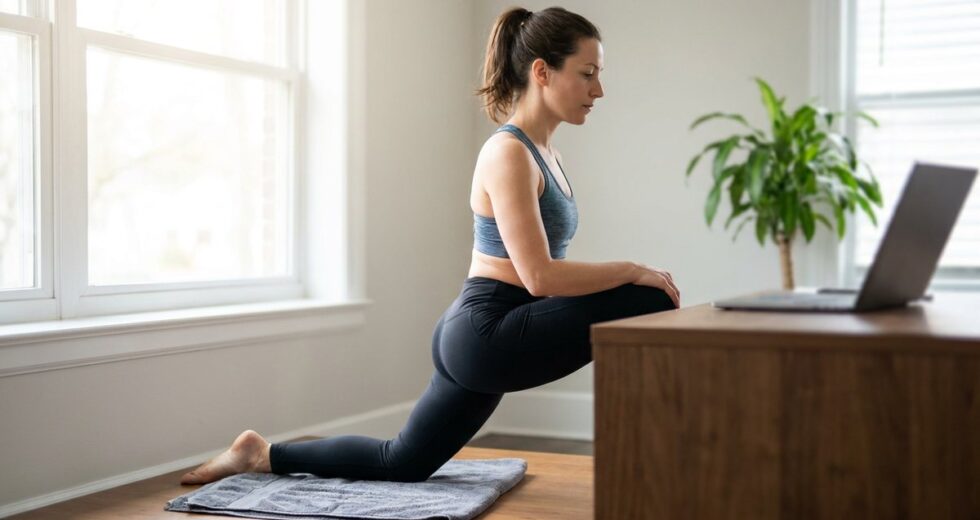
Do a half-kneeling hip flexor stretch with your tailbone tucked: hold it for 30 seconds, twice on each side, on 5 days a week. The 30-second hold comes from hamstring trials (Bandy and Irion, 1994); no trial cited here tested hold times for hip flexors in desk workers.
Whether sitting shortens hip flexors is unproven. People who were inactive and sat over 7 hours a day had 6.1 degrees less passive hip extension than active people who sat under 4 hours, an association that cannot show cause (Boukabache et al., 2021).
Does sitting shorten your hip flexors? What the research found
| Study | Design | Result |
|---|---|---|
| Boukabache et al., 2021, Musculoskelet Sci Pract | Cross-sectional, 144 people tested, 98 sorted into three groups | 6.1 degrees more passive hip extension in the high-activity, minimal-sitting group than in the low-activity, prolonged-sitting group |
| Baker et al., 2018, Int J Environ Res Public Health | 20 adults, 2 hours of laboratory computer work | Discomfort rose in all body areas, clinically meaningfully in the low back and hip, thigh and buttock |
| Winters et al., 2004, Phys Ther | Randomized trial, 33 patients with limited hip extension, active versus passive home stretching | Hip extension range improved in both groups, with no difference between them |
Baker and colleagues found that two hours of sitting raised hip and low back discomfort. Their low back angle moved toward less lordosis, meaning a flatter, less arched lower back.
Nothing cited here separates tight hip flexors from simply staying in one position.
Hip flexor stretches for desk workers: holds, reps and schedule
The holds, reps, sets and weekly schedule below were written for this article as a cautious starting point. No trial tested them in desk workers.
| Stretch | How to do it | Dose per set |
|---|---|---|
| Half-kneeling stretch with pelvic tilt | Kneel on one knee on a folded towel, other foot flat in front. Tuck your tailbone under and squeeze the back-leg glute, then shift your hips slightly forward until the front of the back hip pulls. | 30-second hold, 2 per side |
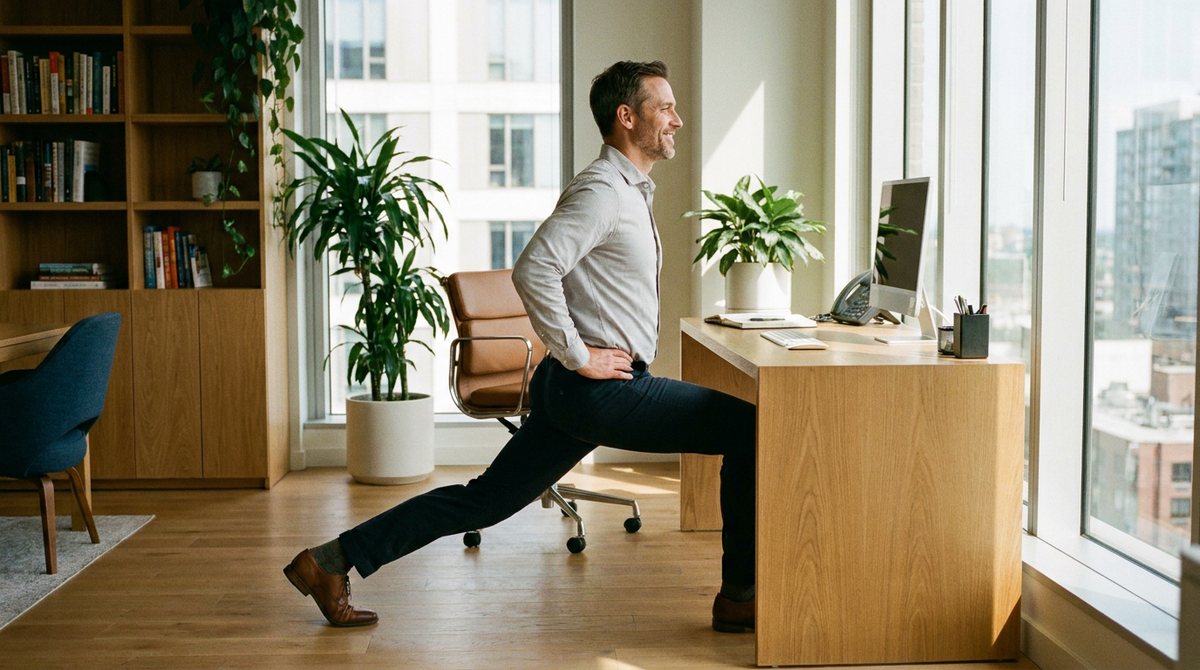
| Standing split-stance stretch | Stand beside your desk in a long step stance, back heel lifted. Tuck your pelvis, keep your ribs stacked over your hips and lean forward gently. | 30-second hold, 2 per side |
| Edge-of-bed stretch | Sit near the edge of a bed and roll back. Hug one knee to your chest and let the other thigh relax down toward the bed. | 30-second hold, 2 per side |
Do the half-kneeling and standing stretches on 5 days a week. That is 1,200 seconds a week, close to the 1,165-second weekly average of the programs in the Freitas review. Use the edge-of-bed version if you cannot kneel.
Give the plan 6 weeks, then check whether standing up after a long sit feels easier. If not, drop it.
Where the 30-second hold comes from
Bandy and Irion randomized 57 adults aged 21 to 37 with tight hamstrings to 15, 30 or 60 seconds of stretching, or none, 5 days a week for 6 weeks.
Thirty and 60 seconds beat 15 seconds and no stretching, with no gap between 30 and 60 (Bandy and Irion, 1994).
A follow-up trial of 93 adults found no extra flexibility from 60 seconds, or from stretching three times a day instead of once (Bandy et al., 1997). Those were hamstrings in young adults, so 30 seconds is a guess for your hip flexors.
The tailbone tuck has one small trial behind it. In 26 healthy, active adults averaging 22 years old, a half-kneeling stretch with posterior pelvic tilt lowered reactive hip flexor force by 4.85 N·m, against 0.06 N·m for the conventional stretch (González-de-la-Flor et al., 2024).
That was a force test, not hip range or pain.
If kneeling is out, our chair yoga sequence has gentle seated moves, though it was not built for hip flexors.
The Winnipeg Regional Health Authority video below shows a hip flexor stretch for stiffness from sitting all day.
Fitting it into a work day
A Cochrane review of 34 workplace studies with 3,397 participants found that sit-stand desks cut sitting at work by about 100 minutes a workday at up to 3 months (low-quality evidence; Shrestha et al., 2018).
In one study, one to two minute breaks every half hour cut sitting by 40 minutes a day versus two 15-minute breaks.
Neither result involved stretching. Try a half-hour timer, with the standing split-stance stretch on every second break.
Common hip flexor stretching mistakes
| Mistake | What the evidence says | Fix |
|---|---|---|
| Lunging forward with an arched lower back | The conventional stretch changed reactive hip flexor force by 0.06 N·m, versus 4.85 N·m with a pelvic tilt (González-de-la-Flor et al., 2024) | Tuck your tailbone and squeeze the back-leg glute before you shift forward |
| Stretching once at night after sitting all day | Discomfort built within 2 hours of sitting (Baker et al., 2018); no trial tested a single evening stretch against breaks | Stand up every half hour and stretch on every second break |
| Expecting the stretch to fix your posture | In 20 healthy people after 3 weeks, passive hip extension rose but pelvic tilt and lumbar extension during running did not change (Mettler et al., 2019) | Judge the plan by how lunging and standing up feel |
| Expecting the muscle to get longer | In 26 studies of 3 to 8 weeks, muscle and tendon stiffness changed trivially; adaptations were mostly sensory (Freitas et al., 2018) | Expect less tightness first and keep the habit going |
Do hip flexor stretches help low back pain?
The support is weak. Hatefi and colleagues randomized 30 women with nonspecific low back pain to 8 weeks of stretching or a control group.
Pain, disability and hip range improved over time in the stretching group, but the group-by-time interactions were not significant (Hatefi et al., 2021).
So the trial did not show stretching beating the control group, even though the authors wrote that back pain might be partly related to hip flexor tightness.
If your back is the main problem, start with our lower back pain exercises plan.
Who should be careful and when to see a clinician
Hip pain has many causes, including arthritis and fracture, and the NHS says not to diagnose it yourself.
For nonspecific low back pain, the one trial cited here found hip flexor stretching did not beat a control group (Hatefi et al., 2021, covered above).
These conditions need a clinician’s input before you add hip stretches:
- Femoroacetabular impingement syndrome: diagnosis needs symptoms, positive clinical signs and imaging, and the Warwick consensus lists conservative care, rehabilitation and surgery as suitable treatments (Griffin et al., 2016). Its abstract says nothing about stretching, and no trial cited here tests hip flexor stretches for it. As a rule of thumb with no trial behind it, a deep pinch in the groin is a reason to be assessed.
- Hip osteoarthritis: the NHS says most hip replacements are done for osteoarthritis, and its options to try first include low-impact exercise such as swimming, walking or cycling, and muscle strengthening in the hips.
- Hip replacement: the NHS recovery advice says not to bend the hip more than 90 degrees and to follow your physiotherapist’s exercises. The half-kneeling position bends the front hip, so ask your surgeon or physiotherapist before adding any stretch.
- Pregnancy-related pelvic girdle pain: the NHS describes it as stiff or unevenly moving pelvic joints and lists physiotherapy with strengthening of the pelvic floor, stomach, back and hip muscles. It advises staying active but avoiding what makes the pain worse, so ask your midwife or doctor first.
The NHS says to see a doctor (it says GP) if hip pain stops normal activities or affects sleep, keeps getting worse or coming back, has not improved after 2 weeks of home care, or comes with stiffness lasting over 30 minutes after waking.
Get same-day medical care for severe hip pain that began suddenly without a fall, a hot or swollen hip, skin color change, or hip pain with fever.
Call 911 or go to the emergency room for severe hip pain after a fall or injury, being unable to walk or put weight on the leg, or tingling or loss of feeling after an injury. The NHS lists the same triggers for its emergency number, 999.
Frequently asked questions
How long should you hold a hip flexor stretch?
Thirty seconds is a reasonable starting point. In hamstring trials, 30 seconds improved flexibility as much as 60 seconds, and both beat 15 seconds (Bandy and Irion, 1994). No trial tested hip flexor hold times in desk workers, so treat 30 seconds as an estimate and stop if you feel pinching.
How often should desk workers stretch their hip flexors?
The plan above uses two stretches on 5 days a week, plus a stand-up break every half hour. No trial tested that schedule. Hamstring work found no extra flexibility from stretching three times a day instead of once (Bandy et al., 1997), so extra sessions may add nothing.
Do tight hip flexors cause lower back pain?
That is unproven. A trial of 30 women with low back pain found no significant group-by-time difference between 8 weeks of hip stretching and a control group (Hatefi et al., 2021). Two hours of sitting raised low back and hip discomfort (Baker et al., 2018), but that study did not measure hip flexor tightness.
Should a hip flexor stretch hurt?
A mild pull at the front of the hip is the target, and sharp or pinching pain means stop. The NHS advises people with hip pain to avoid putting too much strain on the hip and not to overdo things. See a clinician if a pinch recurs or pain lasts beyond 2 weeks.
When should you see a doctor about hip pain?
The NHS says to see a doctor if hip pain stops normal activities or sleep, keeps worsening, has not improved after 2 weeks of home care, or comes with morning stiffness over 30 minutes. Severe sudden pain or a hot swollen hip needs same-day care. After a fall, call 911 for severe pain or if you cannot bear weight.
Sources
- Boukabache A, et al. Musculoskelet Sci Pract. 2021. PubMed 33188982
- Baker R, et al. Int J Environ Res Public Health. 2018. PubMed 30087262
- Winters MV, et al. Phys Ther. 2004. PubMed 15330693
- Mettler JH, et al. J Strength Cond Res. 2019. PubMed 29927892
- Hatefi M, et al. J Exp Orthop. 2021. PubMed 34318348
- Freitas SR, et al. Scand J Med Sci Sports. 2018. PubMed 28801950
- Bandy WD, Irion JM. Phys Ther. 1994. PubMed 8066111
- Bandy WD, Irion JM, Briggler M. Phys Ther. 1997. PubMed 9327823
- González-de-la-Flor Á, et al. BMC Musculoskelet Disord. 2024. PubMed 39462416
- Shrestha N, et al. Cochrane Database Syst Rev. 2018. PubMed 30556590
- Griffin DR, et al. Br J Sports Med. 2016. PubMed 27629403
- NHS. Hip pain in adults.
- NHS. Hip replacement.
- NHS. Pelvic pain in pregnancy.
- Winnipeg Regional Health Authority. Hip flexor stretch (video).