
A good desk posture routine is six moves: a doorway chest stretch, thoracic extension over a chair back, shoulder blade squeezes, wall angels, a hip flexor stretch and glute bridges. Together they take about 10 minutes. Add short walk or stand breaks through the day. Breaks are the part with the best trial support, though that trial gave no break length.
The moves are worth doing because they get you out of one position. Researchers have looked hard for a link between how you sit and whether your back or neck hurts, and the link is weak. People with certain spine or bone conditions should check with a clinician first.
Your desk posture routine at a glance
| Exercise | Sets | Reps or hold | When |
|---|---|---|---|
| Doorway chest stretch | 2 | 30 second hold | Mid-morning |
| Seated thoracic extension over a chair back | 2 | 8 slow reps | Mid-morning |
| Shoulder blade squeeze | 2 | 10 reps, 5 second hold each | After lunch |
| Wall angel | 2 | 8 slow reps | After lunch |
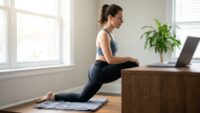
| Standing hip flexor stretch | 2 per side | 30 second hold | Mid-afternoon |
| Glute bridge | 2 | 10 reps | End of the workday |
| Walk or stand break | Every 30 minutes | 2 minutes | Throughout the day |
The holds and reps add up to roughly 10 minutes, split into three short blocks.
These doses are starting points, not trial-tested numbers. The abstracts of the trials cited below do not report hold times or reps for individual moves, so nobody can tell you that 30 seconds beats 20.
How to do each posture exercise
Doorway chest stretch
- Stand in a doorway and rest your forearms on the frame, elbows level with your shoulders.
- Step one foot forward until you feel a stretch across the front of your chest.
- Hold for 30 seconds while you breathe normally, then repeat once.
Seated thoracic extension
- Sit on a chair with a firm back and clasp your hands behind your head.
- Lean back over the top edge of the backrest, aiming for the middle of your back and not your lower back.
- Return to upright and repeat for 8 slow reps.
For a wall angel, stand with your back near a wall, bend your elbows to 90 degrees and slide your arms up without letting your lower back arch. For a glute bridge, lie on your back with knees bent and lift your hips until your body forms a line from shoulder to knee.
Our guide to hip flexor stretches for desk workers covers that stretch in detail. Neck-specific work deserves its own guide, so this routine stays on your whole body.

Does bad posture cause back or neck pain?
Mostly the evidence says no. A 2019 viewpoint in the Journal of Orthopaedic and Sports Physical Therapy notes the common belief that spinal pain comes from sitting, standing or bending “incorrectly”. The authors cite “the absence of strong evidence” for it and a large posture industry that grew up anyway (Slater et al., 2019).
That is an expert opinion, not a trial. The studies in the next section carry the data.
What the research says about posture and pain
| Study | Design | Size | Finding |
|---|---|---|---|
| Hartvigsen 2000, Scand J Public Health | Systematic review, sitting at work and low back pain | 35 reports, 8 of acceptable quality | All but one failed to find a positive association between sitting while working and low back pain |
| Christensen 2008, J Manipulative Physiol Ther | Systematic review, spinal curves and health | 54 studies | No strong evidence of an association between sagittal spinal curves and any health outcome, including spinal pain |
| Richards 2016, Phys Ther | Cross-sectional, 17-year-olds | 1,108 | No significant difference in odds of neck pain or headache across four sitting posture clusters |
| Richards 2021, Phys Ther | Prospective cohort, ages 17 and 22 | 686 | In females, slumped sitters had lower odds of persistent neck pain than upright sitters; no association in males |
| Akkarakittichoke 2021, Musculoskelet Sci Pract | Cluster-randomized trial, 12 months | 193 high-risk office workers | Active breaks and postural shifts shortened recovery and cut recurrence of neck and low back pain |
| Shariat 2018, Braz J Phys Ther | Randomized trial, 6 months | 142 office workers | Stretching lowered pain scores at the neck, shoulders and lower back versus no treatment |
The 2021 Richards study is the most telling. Neck pain at age 17 was associated with neck pain at 22 (OR 3.78, 95% CI 2.57 to 5.57), and in females the slumped thorax and forward head group had an odds ratio of 0.24 (95% CI 0.08 to 0.76) against upright sitters. The authors say generic advice to sit up straight “needs rethinking” (Richards et al., 2021).
The 2016 paper covers 17-year-olds only, so it may not apply to you (Richards et al., 2016).
The older reviews have weak spots. Christensen rated the included studies as generally low in methodological quality (Christensen and Hartvigsen, 2008).
Hartvigsen searched literature from 1985 to 1997, and its one outlier tied sitting in a poor posture to low back pain, in a low-quality study (Hartvigsen et al., 2000). Observational data cannot rule out that posture matters for some individuals.
So is there a correct way to sit? None of these studies identifies one.
Do posture exercises actually help?
They help people who have pain, though the trial measured discomfort and not posture. In the 142-person Shariat trial, office workers with neck, shoulder and lower back pain got stretching, ergonomic changes, both, or no treatment.
Against the control group, stretching lowered neck pain scores by 10.55 points (95% CI -14.36 to -6.74) and lower back scores by 7.8 points (95% CI -11.08 to -4.53) on the Cornell questionnaire. Only the exercise group kept improving between months 4 and 6 (Shariat et al., 2018).
The control group got nothing, so the trial cannot separate the exercises from the effect of attention. It reports pain, not shoulder or head position, so it cannot say the stretches changed how you sit.
For back-specific work, see our lower back pain exercises plan.
What happens when you move more often at work
One trial of a movement-first approach followed 193 high-risk office workers for 12 months. One group got custom apparatus to facilitate active breaks, another got apparatus to facilitate postural shifts, and controls got a placebo seat pad.
Median recovery took 1 month in both intervention groups and 2 months in controls. Recurrence of neck and low back pain was 21% with active breaks, 18% with postural shifts and 44% in controls (Akkarakittichoke et al., 2021).
The adjusted hazard ratio for recurrence was 0.22 (95% CI 0.06 to 0.83) for active breaks and 0.35 (95% CI 0.16 to 0.77) for postural shifts.
Those workers were selected as high risk and used custom equipment, so the trial does not tell you how much a phone timer would do. Its abstract does not say which part of the interventions did the work.
A gentler seated option is in our chair yoga guide.
Who should be careful with posture exercises
This routine is for ordinary stiffness and aches after sitting. Talk to a clinician before you start if any of these describe you:
- You have been diagnosed with Scheuermann’s kyphosis or another rigid spinal curve.
- You have osteoporosis or have had a vertebral fracture.
- You have ankylosing spondylitis, or a doctor has raised it.
- Your back pain began after a fall, a car crash or another injury.
- You have numbness, tingling or weakness in an arm or leg.
- You are pregnant, which changes which positions are comfortable and safe to hold.
Sudden loss of bladder or bowel control, or numbness between your legs, needs emergency care.
A generic desk routine is not a treatment for a rigid curve. Scheuermann’s kyphosis is a developmental deformity affecting up to 8% of children in the US and an important cause of structural or rigid kyphosis (O’Donnell et al., 2023). Treatment depends on curve size and symptoms, and may include supervised physical therapy or bracing, which is a specialist’s call.
With osteoporosis, the wrong exercise can do harm. In a 1984 study of 59 postmenopausal women with spinal osteoporosis, additional compression fractures occurred in 89% of the 9 women doing flexion exercises and 16% of the 25 doing extension exercises (Sinaki and Mikkelsen, 1984). The study is small and old, yet it is the reason to ask first.
For ankylosing spondylitis, a Cochrane review of 11 trials with 763 participants found small differences in spinal mobility favoring supervised group physiotherapy over home exercises (Dagfinrud et al., 2008). A generic desk routine does not replace a program from your care team.
Not every red flag is equally informative. A review found many guideline red flags change the probability of fracture or malignancy very little. A history of malignancy raised the probability of spinal malignancy to 33% (95% CI 22% to 46%), and prolonged corticosteroid use raised the probability of fracture to 33% (95% CI 10% to 67%) (Downie et al., 2013).
Frequently asked questions
What are the best posture exercises for sitting at a desk?
No trial has ranked individual moves. A reasonable set covers your chest, mid-back, shoulder blades and hips: a doorway chest stretch, thoracic extension, shoulder blade squeezes, wall angels, a hip flexor stretch and glute bridges. Pair them with a short walk or stand break every 30 minutes.
Does bad posture cause back pain?
The evidence is weak. A systematic review of 35 reports found that all but one failed to find a positive association between sitting while working and low back pain (Hartvigsen et al., 2000). A review of 54 studies found no strong evidence linking sagittal spinal curves to spinal pain (Christensen and Hartvigsen, 2008).
How long should you do posture exercises each day?
The routine above takes about 10 minutes, split into three blocks. That figure is a practical starting point, not a trial result, because the abstracts of the trials cited here give no daily dose. If your symptoms are not improving after a few weeks, see a clinician.
Is there a perfect sitting posture?
Research has not found one. In a cohort of 686 young adults, slumped sitters at 17 had no higher odds of persistent neck pain at 22 than upright sitters, and lower odds in females (Richards et al., 2021). Prompts to change position cut pain recurrence in office workers (Akkarakittichoke et al., 2021).
Can posture exercises fix rounded shoulders?
The trials cited here measured pain and not shoulder position, so they cannot answer that. Stretching did reduce pain in office workers (Shariat et al., 2018). If a visible curve is rigid or worsening, see a clinician, because a generic routine is not a treatment for a structural curve.
Sources
- Slater D, Korakakis V, O’Sullivan P, Nolan D, O’Sullivan K. “Sit Up Straight”: Time to Re-evaluate. J Orthop Sports Phys Ther. 2019. PubMed.
- Hartvigsen J, Leboeuf-Yde C, Lings S, Corder EH. Is sitting-while-at-work associated with low back pain? A systematic, critical literature review. Scand J Public Health. 2000. PubMed.
- Christensen ST, Hartvigsen J. Spinal curves and health: a systematic critical review of the epidemiological literature dealing with associations between sagittal spinal curves and health. J Manipulative Physiol Ther. 2008. PubMed.
- Richards KV, Beales DJ, Smith AJ, O’Sullivan PB, Straker LM. Neck Posture Clusters and Their Association With Biopsychosocial Factors and Neck Pain in Australian Adolescents. Phys Ther. 2016. PubMed.
- Richards KV, Beales DJ, Smith AL, O’Sullivan PB, Straker LM. Is Neck Posture Subgroup in Late Adolescence a Risk Factor for Persistent Neck Pain in Young Adults? A Prospective Study. Phys Ther. 2021. PubMed.
- Akkarakittichoke N, Waongenngarm P, Janwantanakul P. The effects of active break and postural shift interventions on recovery from and recurrence of neck and low back pain in office workers: A 3-arm cluster-randomized controlled trial. Musculoskelet Sci Pract. 2021. PubMed.
- Shariat A, Cleland JA, Danaee M, Kargarfard M, Sangelaji B, Tamrin SBM. Effects of stretching exercise training and ergonomic modifications on musculoskeletal discomforts of office workers: a randomized controlled trial. Braz J Phys Ther. 2018. PubMed.
- O’Donnell JM, Wu W, Youn A, Mann A, Swarup I. Scheuermann Kyphosis: Current Concepts and Management. Curr Rev Musculoskelet Med. 2023. PubMed.
- Sinaki M, Mikkelsen BA. Postmenopausal spinal osteoporosis: flexion versus extension exercises. Arch Phys Med Rehabil. 1984. PubMed.
- Dagfinrud H, Kvien TK, Hagen KB. Physiotherapy interventions for ankylosing spondylitis. Cochrane Database Syst Rev. 2008. PubMed.
- Downie A, Williams CM, Henschke N, et al. Red flags to screen for malignancy and fracture in patients with low back pain: systematic review. BMJ. 2013. PubMed.