Small grounding trials report lower night-time cortisol and less self-reported pain, but most enrolled fewer than 40 people and several have authors tied to an Earthing company. None shows that grounding treats a disease.
If you are choosing between a grounding mat and going barefoot in the yard, neither is proven, and barefoot carries real risks if you have diabetes or numb feet.
What do grounding benefit studies actually measure?
Grounding, also called earthing, means skin contact with the ground, or contact through a conductive mat, patch or sheet connected to the earth. The table lists the human studies this article draws on, in order of publication.
| Study | Design and size | What was measured | Main limitation |
|---|---|---|---|
| Ghaly and Teplitz, J Altern Complement Med, 2004 | 12 people, conductive mattress pad for 8 weeks | Lower night-time cortisol; symptoms “reduced or eliminated in nearly all subjects” | No comparison group in the abstract |
| Brown, Chevalier and Hill, J Altern Complement Med, 2010 | 8 healthy people, 4 grounded and 4 with systems not connected to the earth | Many markers; those differing by 10% or more were flagged | Built to pick markers for later study |
| Chevalier and colleagues, J Altern Complement Med, 2013 | 10 healthy adults, 2 hours grounded | Red blood cell charge up by an average of 2.70; less clumping | Slide measurement; no clinical outcome |
| Chevalier, Psychol Rep, 2015 | 40 adults, 1 hour grounded or sham-grounded, double-blind pilot | Positive mood improved in the grounded group only | One hour, self-rated mood |
| Brown, Chevalier and Hill, Open Access J Sports Med, 2015 | 32 young men, 16 grounded and 16 sham, after 200 half-knee bends | Creatine kinase rose on day 2 in sham only (between-group P = 0.04) | Both groups reported pain on every post-test day |
| Elkin and Winter, Altern Ther Health Med, 2018 | 10 hypertensive patients, grounded at home 10 or more hours a day | Systolic pressure fell 8.6% to 22.7%, average 14.3% | Case series with no control group |
| Chevalier and colleagues, Explore, 2019 | 16 massage therapists, 6-week stepped wedge trial | Questionnaire pain, function, energy and fatigue scores improved while grounded | 16 people; all outcomes self-reported |
| Lin and colleagues, Healthcare, 2022 | 22 enrolled and 15 finished, mild Alzheimer’s disease, 12 weeks, sham-controlled | Sleep scores (PSQI) differed from sham, 0.3 vs 3.0, P = 0.006; anxiety and depression did not | 15 completers; mild Alzheimer’s disease only |
| Muniz-Pardos and colleagues, Int J Environ Res Public Health, 2022 | 10 elite runners, randomized shoe conditions | Running economy 51.1 vs 50.9 mL per kg per minute, no difference | Shoe insert, 10 runners; adidas employees among the authors |
How is grounding supposed to work?
The 2012 review by Chevalier and colleagues in the Journal of Environmental and Public Health describes earthing as contact with conductive systems that transfer the Earth’s electrons from the ground into the body. Its abstract frames earthing as having the potential to be a modality “of significant clinical importance.”
The studies above measured stand-ins such as saliva cortisol, red blood cell charge and creatine kinase. The abstracts do not show that electron transfer drives those markers, or that the markers predict anything you would feel.
The 2013 blood paper shows the gap. Its title refers to blood viscosity, yet the abstract describes measuring red cell charge and clumping in 10 healthy adults. Its conclusion that grounding reduces blood viscosity and cardiovascular risk goes well past that.
Why is the grounding evidence weak?
The samples are small
Group sizes in the table run from 8 to 40 people, and the 2010 pilot compared 4 grounded subjects with 4 controls. The 2015 follow-up used 32 men and reached P = 0.04 on creatine kinase, a margin where chance can pass for an effect.
Sham grounding is hard to verify
A mat looks identical whether or not it is connected to the earth, so a sham is possible, and several of the trials above used one. The abstracts do not say whether participants guessed their group afterward.
Self-reported pain, sleep and mood move when people expect to feel better, and in the 2019 trial every outcome was a questionnaire.
Several authors have financial ties
The 2012 review discloses that Chevalier, Sinatra and Oschman are independent contractors for the company sponsoring earthing research and own a small percentage of its shares.
In the 2015 muscle study, Brown was hired as a contractor by Earth FX and Chevalier has been a contractor since 2007.
That 2015 disclosure also says the company played no role in study design, data analysis or writing. A disclosed tie does not make results false, but the work needs outside replication before you rely on it.
Independent replications are few
Among the trials in the table, the only sham-controlled sleep trial is the 2022 pilot by Lin and colleagues at a Taiwanese hospital, and it reports no conflict of interest.
A 2025 review by Kshirsagar and colleagues in the Journal of Alzheimer’s Disease calls the preliminary evidence promising and asks for clinical trials. A randomized test of grounding shoes in elite runners, by Muniz-Pardos and colleagues, found no change.
Does grounding help with sleep, soreness or blood pressure?
Sleep has two trials and thin controls: one pilot with no comparison group in its abstract, and one sham-controlled trial with 15 completers.
Soreness has two small sham-controlled trials, with 8 people and 32 men. In the larger one, a muscle-damage marker rose only in the sham group while both groups still hurt. Our tips for avoiding muscle soreness after a workout cover the usual recovery habits.
Blood pressure rests on a 10-patient case series with no control group, which cannot show that grounding lowers it. Mood comes from a one-hour pilot; our look at using nature to ease anxiety offers a lower-risk way to spend time outdoors.
Should you try grounding, and how?
If you experiment anyway, rate your sleep or soreness each morning for a week before you start, then keep rating. Expectation can lift scores, so your own before-and-after gain proves less than the sham-controlled trials did.
| Option | What the evidence covers | Main catch |
|---|---|---|
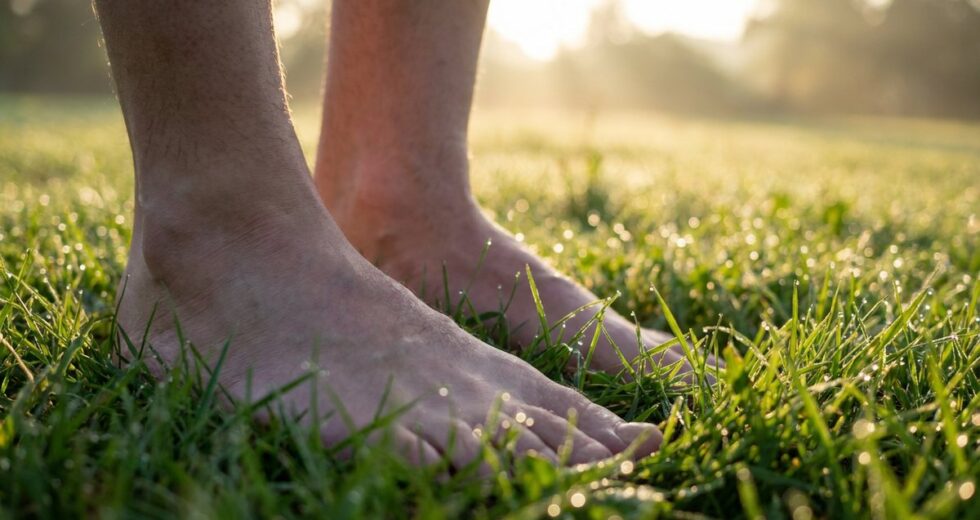
| Walking barefoot on grass or soil | Listed in the 2012 review as one form; the trials used patches, mats and sheets, not lawns | Cuts, and a real risk if you have diabetes with reduced foot feeling |
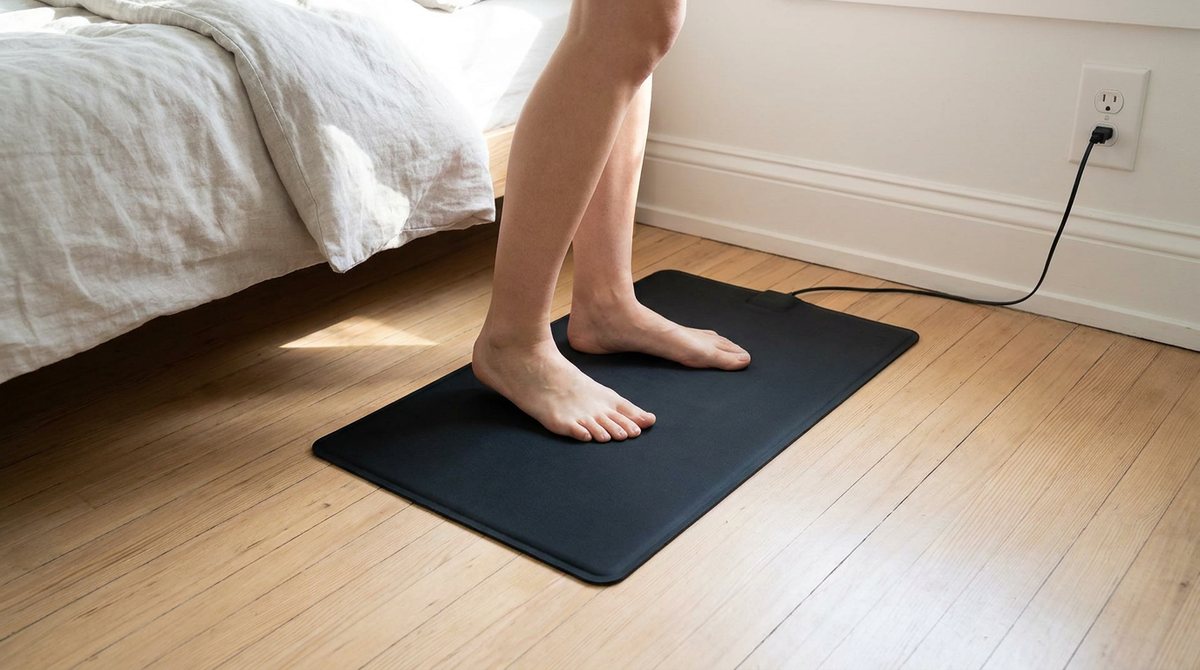
| Conductive mat or sheet | Used in the sleep, mood and muscle trials in the table | Some connect to a wall outlet’s ground port, so wiring matters |
| Grounding shoes | One test in 10 elite runners found no change in running economy | Little other human data |
| Treating the underlying problem | Sleep apnea and high blood pressure have established care | Needs a clinician; grounding is not a replacement |
Who should be careful with grounding?
Diabetes, nerve damage or foot wounds
The National Institute of Diabetes and Digestive and Kidney Diseases advises people with diabetes to wear shoes and socks at all times and not to walk barefoot, even indoors, because you can step on something and feel no pain.
If you have neuropathy or an open sore, skip barefoot grounding and ask your care team.
Products plugged into an outlet
Some mats connect to the ground port of a wall outlet; the mat in a 2024 rat study by Ye and colleagues was wired that way. The National Fire Protection Association says to call a qualified electrician or your landlord if an appliance tingles when touched or an outlet is warm or discolored.
Blood thinners and implanted devices
The blood claim rests on 10 healthy adults and a slide measurement. Nothing in that abstract shows grounding affects how an anticoagulant works, so ask your prescriber first.
None of the abstracts above mention people with pacemakers or other implanted electrical devices. Ask your device clinic before using a mat that connects to an outlet.
Where grounding is no substitute for treatment
In Lin’s trial, anxiety and depression scores in mild Alzheimer’s disease did not change significantly against sham, and the shoe test found no running benefit. A 10-patient case series is no reason to lower or skip blood pressure medicine.
Loud snoring with gasping or breathing pauses can signal sleep apnea, according to the National Heart, Lung, and Blood Institute. No trial in the table tested grounding for sleep apnea, so a mat is no substitute for a sleep study.
Watch: Cleveland Clinic on earthing
Frequently asked questions
Does grounding really work?
The evidence is too thin to say. Small trials report lower cortisol and less pain, but most enrolled fewer than 40 people, several relied on self-reported outcomes, and some authors have ties to an Earthing company. A 2022 shoe test in 10 elite runners found no difference in running economy.
Do grounding mats help you sleep?
Possibly, though the proof is weak. Ghaly’s 2004 pilot of 12 people had no comparison group in its abstract, and Lin’s 2022 sham-controlled trial in mild Alzheimer’s disease reported better sleep scores in 15 completers. Neither is large enough to settle it.
Is it safe to walk barefoot outside?
The main hazard is stepping on something. If you have diabetes, NIDDK advises wearing shoes and socks at all times because you may not feel an injury. With neuropathy, foot sores or poor circulation, talk with your clinician before you go barefoot outdoors.
Can grounding lower blood pressure?
No controlled trial in this article shows that. The one study is a 2018 case series of 10 hypertensive patients with no control group, where systolic pressure fell an average of 14.3%. Keep taking prescribed medicine and discuss any change with your prescriber.
Who funds grounding research?
Some of it comes from authors with disclosed ties to Earthing companies: the 2012 review lists three contractors who own shares, and the 2015 muscle study lists two contractors. Lin’s 2022 trial reports no conflict of interest, while four authors of the 2022 shoe test are adidas employees.
Sources
- Ghaly M, Teplitz D. J Altern Complement Med. 2004. PubMed.
- Brown D, Chevalier G, Hill M. J Altern Complement Med. 2010. PubMed.
- Chevalier G, Sinatra ST, Oschman JL, et al. J Environ Public Health. 2012. PubMed.
- Chevalier G, Sinatra ST, Oschman JL, et al. J Altern Complement Med. 2013. PubMed.
- Chevalier G. Psychol Rep. 2015. PubMed.
- Brown R, Chevalier G, Hill M. Open Access J Sports Med. 2015. PubMed.
- Elkin HK, Winter A. Altern Ther Health Med. 2018. PubMed.
- Chevalier G, Patel S, Weiss L, et al. Explore. 2019. PubMed.
- Lin CH, Tseng ST, Chuang YC, et al. Healthcare. 2022. PubMed.
- Muniz-Pardos B, Zelenkova I, et al. Int J Environ Res Public Health. 2022. PubMed.
- Kshirsagar S, Deshmukh H, Reddy AP, et al. J Alzheimers Dis. 2025. PubMed.
- Ye M, Jeong W, Yu HJ, et al. Int J Mol Sci. 2024. PubMed.
- NIDDK. Diabetes and foot problems.
- NFPA. Electrical safety in the home.
- NHLBI. Sleep apnea symptoms.
- Cleveland Clinic. Is earthing good for you? (video).