

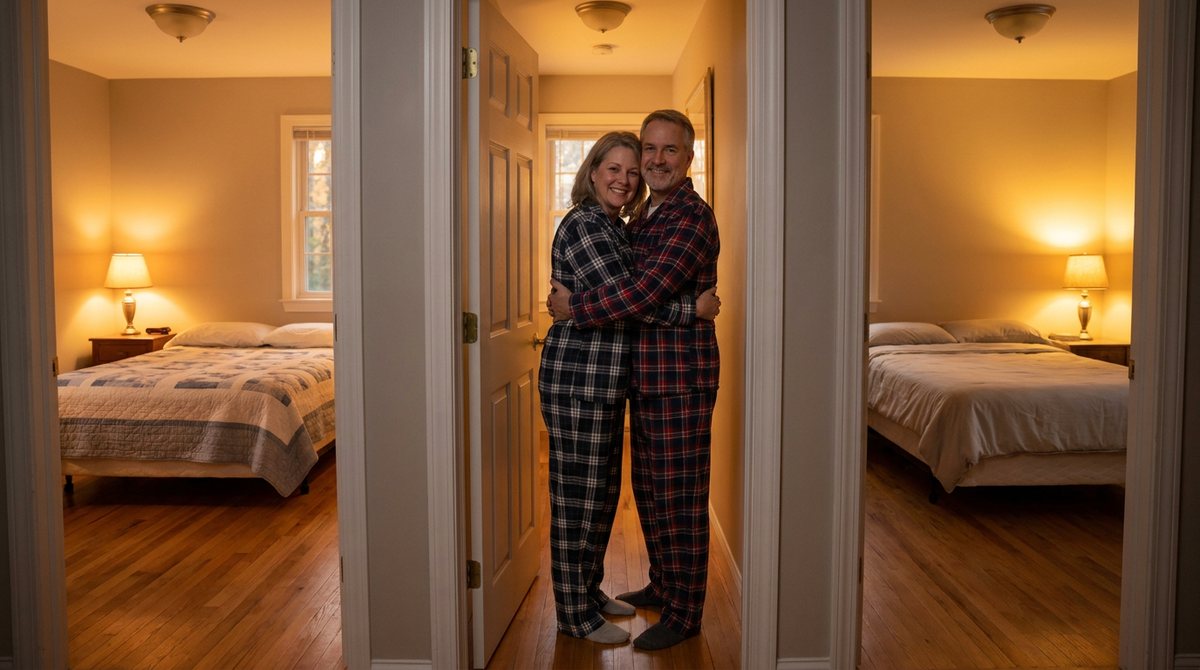
A sleep divorce means you and your partner sleep apart on purpose, in separate beds or rooms, and stay together. The research does not call it good or bad. Sharing a bed has real sleep costs, mainly movement and noise, and benefits that are easy to lose.
If one of you wakes up tired every day, this is worth understanding. Below are the sleep studies, the setups to choose from, a way to try one, and the conditions where moving rooms will not fix the underlying problem.
What does the research say about sleeping next to a partner?
Most evidence comes from small studies, and it points two ways. Couples often rate their sleep better together while sensors record more disturbance.
A 2021 scoping review by Andre and colleagues in Sleep Health covered bed sharing with partners, children, siblings and pets. Across those pairings, people generally reported better sleep quality when bed sharing, despite generally worse objective sleep measures.
| Study | Who and how | What it found |
|---|---|---|
| Pankhurst and Horne, Sleep, 1994 | 46 bed-partner pairs, wrist actimetry for 8 nights | 5 to 6% of 30-second epochs held movements, and about a third were shared by both partners. Movements dropped when the usual partner was away. Most reported sleeping better with their partner present. |
| Drews and colleagues, Front Psychiatry, 2020 | Young healthy couples, lab polysomnography alone and together | Co-sleeping went with about 10% more REM sleep, less fragmented REM and more limb movements. Other sleep stages did not change significantly. |
| Rayward and colleagues, Sleep Health, 2026 | Systematic review | All 4 studies on partner disturbance found it. Two of 3 found more REM when co-sleeping. Methods varied and samples were small, and no single mechanism explained the net effect. |
The lab couples were young and healthy, so they say little about a 55-year-old with a snoring spouse. None of these studies tested a long-term move to separate bedrooms.
The term appears in a 2025 narrative review by Andersen and colleagues in the Journal of Health Psychology. They discuss sleep divorce as a potential strategy and call for research on long-term effects of different arrangements.
Why does a bed partner disrupt your sleep?
Movement is the baseline cost. Pankhurst and Horne found that people sleeping with a partner moved more than matched people who slept alone. Female bed partners reported being disturbed more often than male partners did.
Snoring is the louder cost. In a 1999 Mayo Clinic Proceedings study, Beninati and colleagues recorded 10 married couples at once while one spouse was tested for suspected obstructive sleep apnea. Midway through, that patient received CPAP.
The patients’ median apnea-hypopnea index fell from 26 to 7. Their spouses’ median arousal index fell from 21 to 12, and sleep efficiency rose from 74% to 87%.
The authors put that at about 62 extra minutes of sleep, assuming 480 minutes in bed. It was a single night, so treat the size loosely.
Insomnia adds another layer. Walters and colleagues tracked 52 couples, one partner with diagnosed insomnia, using actigraphy and diaries for seven nights (Sleep, 2020). Partners received wake transmissions, meaning awakenings right after the other person was awake, at 1.25 times the rate of the patients.
The share of awakenings transmitted was higher in couples with matching bedtimes. That is an association and nobody tested it as a fix, but it is worth testing staggered bedtimes before buying a second bed.
The effects reach daytime. In 405 couples aged 51 to 94, Strawbridge and colleagues (Sleep, 2004) found a spouse’s sleep problems associated with the partner’s depressed mood and unhappy marriage, even after adjusting for the partner’s own sleep. The data were cross-sectional, so direction is unknown.
Troxel and colleagues (Sleep Medicine Reviews, 2007) describe the link between sleep and relationship quality as likely bidirectional.
Which sleep divorce setup fits your situation?
Sleeping apart covers a range of setups, from light changes to a second bedroom. This table goes from lightest to heaviest.
| Setup | Helps with | Costs you | Best fit |
|---|---|---|---|
| Staggered bedtimes | Waking when the other person climbs in | Less time falling asleep together | Mismatched chronotypes or shift schedules |
| Separate blankets | Cover tugging, temperature mismatch | Nothing for noise or movement | Couples whose main complaint is covers or heat |
| Split mattress or two twins pushed together | Motion transfer | A center gap, a second set of sheets | Restless sleepers who want to stay in one bed |
| Separate beds, same room | Motion, different mattress needs | Noise still carries | Couples who want closeness without a shared surface |
| Separate bedrooms | Noise, light, movement, schedule clash | Bedtime closeness, a spare room, and a partner who may not hear alarming sounds | Snoring under evaluation, insomnia, very different schedules |
Start at the top and move down only if the problem remains. With loud snoring, the bottom row treats the symptom while the cause goes unchecked, as covered below.
How do you do a sleep divorce well?
Treat it as an experiment with a review date. Nothing in the research tells you how long a trial should run, so these steps are practical suggestions, not tested protocols.
- Name the actual problem: snoring, restlessness, heat, schedules, or one person lying awake.
- Try the lightest fix from the table for a couple of weeks, tracking mornings in a sleep diary.
- If you move rooms, agree on a trial length and a date to talk about how it went.
- Keep a bedtime ritual together. Ten minutes of talking in one bed before one of you leaves keeps some of the closeness of sharing a bed.
- Plan intimacy on purpose, because moving apart removes the easy default.
- Make the second space good: a mattress you like, darkness you control and a temperature you set.
- Reassess. If the person who moved still sleeps poorly, the partner was not the cause.
Expect an adjustment period. Most people in Pankhurst and Horne’s sample reported sleeping better with their partner present, so you may sleep worse alone at first. If anxiety keeps you awake in the new room, our guide to putting anxiety to bed covers wind-down habits.
Who should be careful before sleeping apart?
In a few situations a sleep divorce can quietly work against your health, so read this before you move the pillows.
Loud snoring, gasping or pauses in breathing
The National Heart, Lung, and Blood Institute lists breathing that starts and stops, frequent loud snoring and gasping for air as sleep apnea symptoms, and adds that you may not know you have them until someone tells you.
That someone is often the person beside you. In separate rooms, nobody may notice the pauses. If your partner describes gasping or silences, ask a healthcare provider about a sleep study before you separate. Our article on snoring and what it can signal explains more.
Sleeping apart does not fix your own apnea
A separate room spares your partner the noise. The snorer’s breathing still stops and restarts, their sleep stays broken, and they may stay tired all day. In Beninati’s study, the partner’s sleep improved when CPAP treated the apnea.
Insomnia disorder
The NHLBI describes chronic insomnia as 3 or more nights a week for more than 3 months, and says cognitive behavioral therapy for insomnia, a 6 to 8 week program, is usually the first treatment.
A partner can worsen a bad night, as Walters found, but a second bedroom does not treat insomnia. If you lie awake most nights, talk with a provider.
Conditions someone watches for at night
If a partner usually notices something overnight, such as a seizure or low blood sugar, ask the clinician managing that condition how to stay safe before changing the arrangement. A monitor, alarm or scheduled check may be part of the answer.
When the move is about more than sleep
The sleep studies cannot tell you what a separate bedroom means for your relationship. If one of you is leaving the bedroom because of conflict, a couples counselor is the right person to ask.
Watch: a news report on sleep divorce
Frequently asked questions
Is a sleep divorce bad for a relationship?
No study listed here tested long-term separate bedrooms against relationship outcomes, so nobody can answer this with data. Andersen’s 2025 review calls for that research. If the arrangement bothers either of you, say so early and revisit the setup together.
Do couples sleep better apart?
It depends on what is wrong. Partner movement and snoring were linked to disturbed sleep in Pankhurst’s and Beninati’s work. Yet Andre’s review found people often rate their sleep higher with a partner, even when measures look worse. Some couples sleep better apart and some do not.
What if snoring is the reason I want to sleep apart?
Ask your partner to be evaluated. Loud snoring with gasping or pauses can point to obstructive sleep apnea, according to the NHLBI. In Beninati’s study, CPAP raised the spouses’ median sleep efficiency from 74% to 87%. A separate room helps you, but evaluation can help both of you.
How do you keep intimacy while sleeping apart?
Decide on it instead of leaving it to chance. Spend bedtime together first, schedule time to connect, and keep affection part of the day. The studies measured sleep rather than intimacy, so these are practical ideas. A couples counselor can help if distance grows.
Should you see a doctor before trying a sleep divorce?
Yes if either of you snores loudly, gasps, has long-lasting insomnia, or has a condition needing overnight monitoring. Otherwise it is a reasonable experiment to try. Treating a sleep disorder matters more than where you sleep, since moving rooms does not change your own breathing or insomnia.
Sources
- Andre CJ, Lovallo V, Spencer RMC. Sleep Health. 2021. PubMed.
- Pankhurst FP, Horne JA. Sleep. 1994. PubMed.
- Drews HJ, Wallot S, Brysch P, et al. Front Psychiatry. 2020. PubMed.
- Rayward L, Green D, Little JP. Sleep Health. 2026. PubMed.
- Andersen ML, Alvarenga TA, Fonseca LH, Tufik S. J Health Psychol. 2025. PubMed.
- Beninati W, Harris CD, Herold DL, Shepard JW Jr. Mayo Clin Proc. 1999. PubMed.
- Walters EM, Phillips AJK, Mellor A, et al. Sleep. 2020. PubMed.
- Strawbridge WJ, Shema SJ, Roberts RE. Sleep. 2004. PubMed.
- Troxel WM, Robles TF, Hall M, Buysse DJ. Sleep Med Rev. 2007. PubMed.
- NHLBI. Sleep apnea symptoms; Insomnia; Insomnia treatment.