
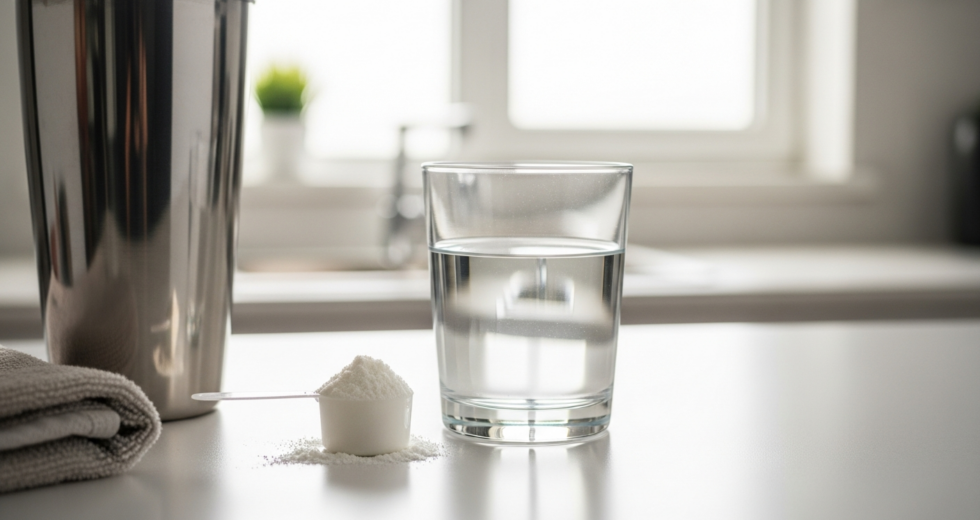
The most effective creatine for women is creatine monohydrate. It is the most extensively studied form, the most affordable, and the one every major sports-nutrition body recommends. If you are shopping for anything more exotic, you are mostly paying for marketing.
That one answer covers a lot of ground. But the questions women actually ask about creatine go deeper: will it cause bloating? Does it affect hormones? Should you cycle it? Those deserve real answers, not a generic supplement-sales pitch.
Below you will find what the research supports, what it does not, and how to use creatine in a way that fits your actual goals.
What Creatine Does in the Female Body
Creatine is a compound your body already produces, primarily in the liver and kidneys. It is stored in muscle tissue as phosphocreatine, where it helps regenerate ATP during short, intense efforts like a heavy squat set or a sprint.
Supplementing with creatine raises those phosphocreatine stores above their natural ceiling. The result: you can push harder in the gym, recover faster between sets, and, over weeks of consistent training, add more lean muscle than you would without it.
Research also points to benefits beyond the gym. Some studies have found creatine supplementation supports cognitive function and mood, particularly under sleep deprivation or high stress. The brain, like muscle, uses ATP at high rates during demanding tasks.
Does Creatine Work Differently for Women?
Women tend to start with lower natural creatine stores than men, which means supplementation produces a relatively larger increase in total creatine availability. That is a good thing.
The hormonal picture is also worth addressing directly. Creatine does not act as a hormone, does not mimic testosterone, and does not raise testosterone levels. It has no meaningful interaction with estrogen or progesterone cycles. The concern about creatine “masculinizing” women is not supported by evidence.
Some women notice improvements in energy and training performance during the luteal phase, when fatigue is more common. This is an area of active research, but the early signals are promising.
The Bloating Question (Answered Honestly)
This is the fear that keeps many women from trying creatine. The short version: water retention is real but often overstated, and it is not the same as fat gain.
Creatine draws water into muscle cells, not under the skin. The result is denser, fuller-looking muscles, not a puffy or soft appearance. Most women who experience initial scale increases of 1-2 lbs find it stabilizes within the first week or two.
If you skip the loading phase (more on that below) and stick to a standard daily dose, the water effect tends to be subtle. Gastrointestinal bloating, the uncomfortable kind, is more likely if you take creatine on an empty stomach or in very large single doses.
Forms of Creatine: What You Will Find on Shelves
Creatine Monohydrate
This is the benchmark. Decades of research, consistently effective, and cheap per gram. Any brand selling you on a “superior absorption” version of creatine is largely working around the fact that monohydrate already absorbs and works extremely well.
Look for products that use Creapure, a branded creatine monohydrate manufactured in Germany to pharmaceutical standards. It is third-party tested for purity and is the form used in most clinical research.
Creatine HCL
Creatine hydrochloride is more water-soluble than monohydrate, which means it mixes more easily and may cause less GI discomfort for some users. The effective dose is smaller by weight, but the cost per serving is higher.
If monohydrate causes stomach issues for you despite taking it with food, HCL is a reasonable alternative. For everyone else, monohydrate is the better value. You can read a full comparison in this breakdown of creatine monohydrate vs HCL that covers the research on both forms.
Creatine Ethyl Ester and Buffered Creatine
Both are marketed aggressively. Neither has demonstrated an advantage over monohydrate in head-to-head research. Creatine ethyl ester in particular has shown less stability during digestion. Skip these unless you have a specific reason your coach or doctor recommends them.
How Much Creatine Women Should Actually Take
The standard research-backed dose is 3 to 5 grams per day. For most women, 3 grams daily is enough to saturate muscle stores over time. There is no strong evidence that going higher produces proportionally better results for women at typical body weights.
You will see some products recommend a loading phase: 20 grams per day split across four doses for the first five to seven days. Loading saturates muscle stores faster, but it also increases the chance of GI discomfort. Skipping the loading phase and taking 3-5 grams daily reaches full saturation in about three to four weeks. Both approaches work.
Timing is flexible. Despite years of debate in fitness communities, current evidence does not strongly favor pre-workout over post-workout over any other time. Take it when you will remember to take it consistently.
What to Look For (and What to Avoid) When Buying
Third-party testing matters here. Supplements are not FDA-regulated the same way pharmaceuticals are, so independent verification of what is actually in the tub is worth seeking. Look for certifications from NSF Certified for Sport, Informed Sport, or USP. These are not marketing badges; they reflect real testing protocols.
Avoid products that blend creatine with large amounts of added sugars, proprietary blends that obscure doses, or formulas that mix creatine with stimulants. You want to know exactly how much creatine you are getting.
Powder is generally more cost-effective than capsules. The taste of unflavored creatine monohydrate is mild enough that it mixes into water, juice, or a protein shake without issue.
Creatine and Strength Training: What the Goals Actually Look Like
Creatine is not a standalone product. It works best when paired with progressive resistance training because the mechanism depends on your muscles being challenged enough to need the extra ATP. If you are only doing low-intensity cardio, the benefit is marginal.
For women focused on toning, building lean muscle, or improving body composition, creatine supports the training work that produces those results. It does not change your body on its own. The goal is stronger training sessions over weeks and months.
If you are new to resistance training, pairing creatine with a structured approach to progressive overload gives you the best shot at seeing measurable results. A good starting framework is covered in this progressive overload schedule for beginners that maps out a 12-week structure.
Women also working on body fat reduction should know that creatine supports muscle retention during a caloric deficit, which matters for body composition outcomes. Losing muscle alongside fat is the most common reason “diets” produce a softer rather than leaner result. If reducing visceral fat specifically is a goal, this guide on how to reduce visceral fat covers the evidence-based protocol.
Is Creatine Safe for Women Long-Term?
The safety profile of creatine at normal doses is well-established. Multiple systematic reviews across decades of research have found no adverse effects in healthy adults taking 3-5 grams daily over extended periods.
The old concern about creatine harming kidneys has been thoroughly investigated and not supported in people with healthy kidney function. If you have an existing kidney condition, check with your doctor before supplementing with anything that affects nitrogen metabolism.
Pregnant and breastfeeding women are typically advised to avoid unnecessary supplementation, not because creatine has been shown to be harmful, but because the specific research in those populations is limited. Again, your doctor is the right person to ask.
For healthy women without underlying conditions, creatine monohydrate at standard doses is among the safest and most studied supplements available.
Common Myths Worth Clearing Up
“Creatine is a steroid.” It is not. Creatine is a naturally occurring compound found in meat and fish. Steroids are a class of synthetic hormones. The comparison is chemically inaccurate.
“Women do not need creatine.” Women produce less creatine endogenously than men and tend to have lower dietary intake if they eat less red meat. If anything, the gap between baseline and supplemented levels may be proportionally larger for women.
“You need to cycle creatine on and off.” No evidence supports this. Creatine does not downregulate its own production in a clinically meaningful way at supplemental doses. Daily, consistent use is the approach backed by research.
FAQ
Does creatine make women bulky?
No. Building significant muscle mass requires years of heavy resistance training and a sustained caloric surplus. Creatine supports the training process; it does not override the fundamentals of body composition. Most women who use it describe looking more toned and defined, not larger.
Should women take creatine every day, even on rest days?
Yes. Maintaining elevated phosphocreatine stores requires consistent daily intake. Taking days off means stores gradually drop back toward baseline. Most protocols recommend the same 3-5 gram daily dose regardless of whether you trained that day.
Can creatine affect your menstrual cycle?
There is no established mechanism by which creatine supplementation disrupts the menstrual cycle. Creatine is not hormonally active. Changes in cycle regularity are far more likely to be explained by training intensity, caloric intake, or stress than by creatine.
How long before you see results from creatine?
Performance improvements can show up within the first one to two weeks as muscle stores saturate. Visible body composition changes take longer and depend heavily on training consistency. Most people notice meaningful differences in strength and endurance within four to six weeks.
Is micronized creatine better than regular creatine monohydrate?
Micronized creatine is simply creatine monohydrate ground into finer particles, which improves how well it dissolves in liquid. The active compound is identical. If you find regular monohydrate gritty or hard to mix, micronized is worth the minor premium. The performance outcome is the same.
Can you take creatine with birth control?
There is no known interaction between creatine and hormonal contraceptives. They work through entirely different biological pathways. If you take other supplements or medications alongside birth control, a quick check with your pharmacist or doctor is always reasonable, but creatine specifically is not a concern in this regard.