
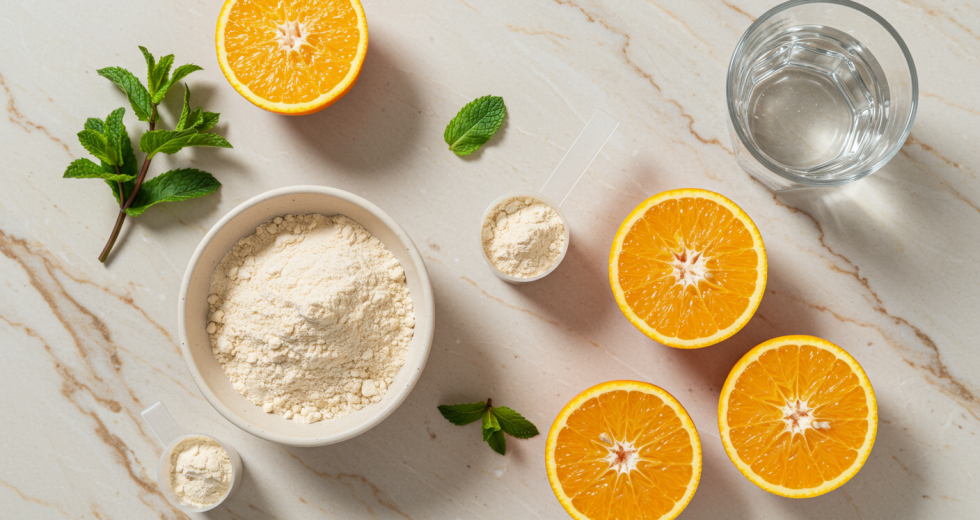
The answer to how much collagen per day for skin depends on your goal: 5g for maintenance and prevention, 10-15g for visible firmness and wrinkle reduction, and 15-20g if you are over 50 targeting crepey texture or deep lines. These numbers come from hydrolysed collagen peptide trials, not gelatin or bone broth studies. The form you choose matters as much as the dose, and so does understanding which factors enhance or block collagen synthesis.
How Much Collagen Per Day for Skin: The Evidence-Based Range
A 2019 systematic review published in the Journal of Drugs in Dermatology, referenced as PMC6835901, pooled data from 805 participants across 11 randomized controlled trials. The tested range ran from 2.5 to 10g per day of hydrolysed collagen peptides. At 2.5g, subjects showed measurable hydration improvement. At 5-10g, skin elasticity, wrinkle depth, and dermal density all improved significantly versus placebo, with stronger outcomes at higher doses.
The clinical floor for visible skin benefit sits at around 5g daily, which is why most single-serve sachets are dosed in that range. Where fibroblast turnover has slowed, as it does progressively after age 40, practitioners scale to 15-20g to compensate for reduced baseline hydroxyproline synthesis. No evidence in the review points to toxicity risk at 20g for healthy adults.
Dose by Age and Skin Goal
Your practical dose shifts with age because collagen production falls roughly 1% per year after your mid-twenties, according to the Cleveland Clinic. The breakdown practitioners use:
- Ages 25-35, maintenance: 5g of hydrolysed Type I+III collagen daily keeps your peptide pool topped up without over-supplementing.
- Ages 35-50, visible firmness: 10-15g per day targets active wrinkle reduction and elasticity, the range most studied in clinical trials.
- Ages 50+, deep wrinkles or crepey texture: 15-20g daily. Clients above 50 who reach 15-20g consistently see crepiness on the inner arms reduce within 8-10 weeks.
- Post-procedure recovery (laser or microneedling): 15g for 4-6 weeks to accelerate extracellular matrix repair.
That covers the practical answer to how much collagen per day for skin at each life stage. One edge case worth knowing: PPIs and achlorhydria reduce stomach acid and lower peptide absorption considerably. This group may see better results with enteric-coated formulations or by pairing the dose with a small acidic drink beforehand.
Type I+III vs Type II for Skin (Why Type Matters)
Skin collagen is almost entirely Type I and Type III, together making up 80-90% of the dermal extracellular matrix. Hydrolysed Type I+III peptides break down into prolyl-hydroxyproline dipeptides, which signal fibroblasts to increase collagen synthesis and suppress matrix metalloproteinase activity, the enzyme class responsible for collagen degradation. This dual action, building new collagen while slowing its breakdown, is why Type I+III supplementation produces measurable skin outcomes in controlled trials.
Type II collagen targets cartilage, not skin. It operates through a different immune mechanism and will not move skin elasticity scores. The form matters practically too: undenatured Type II is heat-sensitive, and adding it to hot coffee destroys the native triple-helix structure, rendering the supplement inert. Hydrolysed Type I+III peptides are already denatured and heat-stable, so mixing them into a hot drink is not a problem.
Timing, Cofactors, and What Cancels It
The hydroxylation of proline, the rate-limiting step in collagen fiber assembly, requires vitamin C as its direct cofactor. Without at least 75-90mg of vitamin C daily, your body cannot produce hydroxyproline at the rate needed to form stable collagen fibers. Pairing 250-500mg of vitamin C alongside your collagen dose meaningfully improves synthesis yield. For related cofactor context, the guides on NAC supplement benefits and best magnesium for sleep cover oxidative stress pathways that also affect skin quality.
Timing is flexible. Morning on an empty stomach and evening before bed produce comparable results in clinical trials. What actually cancels collagen output is not your dosing window but chronic habit: alcohol suppresses the hydroxylation enzymes that make synthesis possible, and smoking accelerates matrix metalloproteinase production, degrading structural collagen faster than any dose can replace it.
When to Expect Results
In cutometry studies, skin elasticity gains become statistically significant at 8-12 weeks of consistent daily supplementation. Nail growth improvement, a reliable proxy for active collagen synthesis, typically appears at 6 weeks. Hydration usually shifts first, around 4-6 weeks, before structural changes become visible. Skin benefits continue building beyond 12 weeks as the dermal extracellular matrix remodels. If you are tracking how much collagen per day for skin produces visible change in photographs, the documentation methods used in mewing before and after photography apply directly here.