
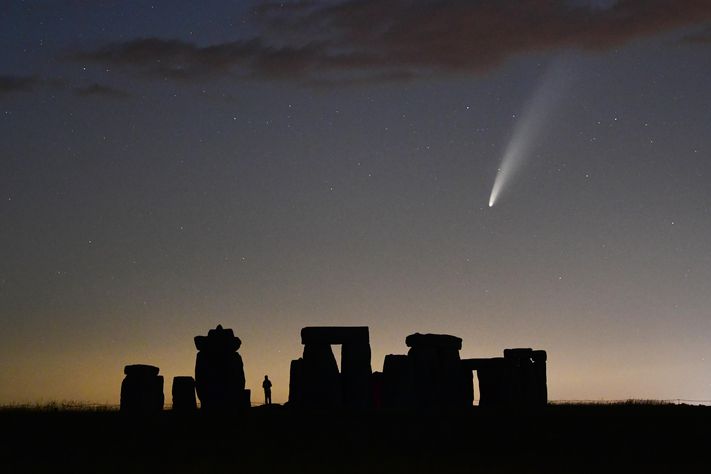
‘Leonard’ sounds more like the name of a character from cartoons rather than a comet, but it will actually be an imposing cosmic object that will delight our views in 2021. You can also call it by its scientific name C/2021 A1, and keep an eye on news that appears on HealthThoroughfare about the subject.
As you might have already guessed, comet Leonard was discovered by a guy named Leonard. His name is Greg Leonard, to be more precise, and he’s a research specialist at the University of Arizona.
Perhaps the only visible comet in 2021 with the naked-eye
Cnet.com brings the news about the Leonard comet that was discovered on January 3 using the Mount Lemmon Observatory, and many of us will get to delight our views with it. There’s also a chance that the comet will break apart into oblivion, but if not, we’ll get to see it in its full glory and dominating the sky around December.
Here is the latest image of comet C/2021 A1 (Leonard). Image taken in almost full moon condition. A possible naked eye object in December.
IC – Denis Buczynski pic.twitter.com/AWDYxRfVuX— Wandering Comet ∆ C.P (@CometWandering) January 31, 2021
https://twitter.com/vivstoitsis/status/1349114015826333699?ref_src=twsrc%5Etfw%7Ctwcamp%5Etweetembed%7Ctwterm%5E1349114015826333699%7Ctwgr%5E%7Ctwcon%5Es1_&ref_url=https%3A%2F%2Fwww.cnet.com%2Fnews%2Fnewfound-comet-named-leonard-may-be-the-one-to-watch-in-2021%2F
C/2021 is also considered an inbound long-period comet, and it was discovered a year before perihelion (the point in the orbit of a cosmic object that is nearest to the host star). At that point, the comet was located at 5 AU from the Sun, meaning about 750 million km. One AU (astronomical unit) means the distance between Earth and the Sun.
Even though the Leonard comet will likely be the only visible comet in 2021 for the naked eye, there are plenty of other notable celestial events that will likely happen in the current year. We’ll have the New Moon from March 13, the March Equinox from March 20, the Earthshine Nights from April 15 and 16, the Lyrid Meteor Shower from April 22/23, the Super Moon from April 27, the Eta Aquarid Meteors from May 5/6, the Total Lunnar Eclipse from May 26, the Annular Solar Eclipse from June 10, and many more.