
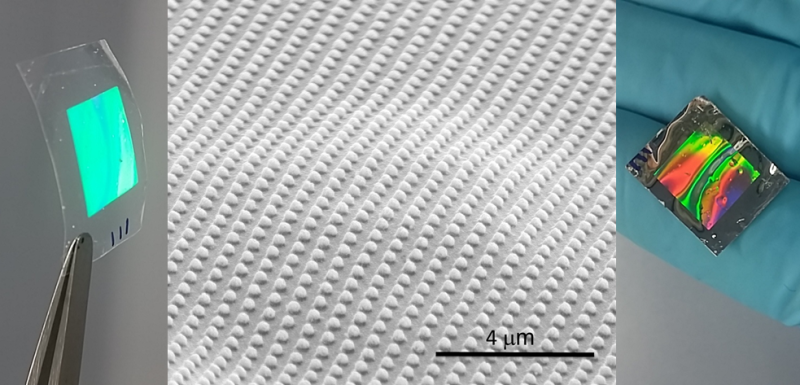
Researchers have created an iridescent material using cellulose from renewable sources, which makes its industrial applications to be numerous. Above all, the new iridescent material is edible.
What makes us see red, blue or green colors is dependent on how the light falls on the surface of the object we observe. An object that’s reflecting light at shorter wavelengths will appear blue, while another object that’s reflecting light at longer wavelengths will appear red.
Adopting this simple principle, the researchers have created a material that, similar to soap bubble or insects’ wings, is iridescent, meaning that is capable of changing the light’s frequency on its surface, thus returning all the base colors, instead of returning just a particular one.
The new iridescent material is made of 100% organic and renewable sources
Researchers have designed this new material from ordinary cellulose, extracted from wood, cotton and other renewable sources.
Unlike older research in this regard, instead of using cellulose fibers, the team of scientists has produced cellulose films. The result was a thin film, of only 1 square centimeter which reflected the light in all the base colors thanks to the spacings between the dots of its composition, according to the study’s report published in Nature Photonics.
Creating such models is not a new trick but the researchers behind this project are particularly enthusiastic about their creation because it is easy to manufacture, is cheap and reproducible.
The applicability of this material is quite varied
Cellulose can be placed over metals, can be washed, eaten, and more. That means that, in the future, we could see this material used in a variety of ways.
Because the material is biocompatible, the newly created iridescent material can be used in food industry, cosmetics, paints, fashion, and so on. However, all these cannot happen soon because, before that, the researchers have to think how to adapt it to mass production in order to make it available for industrial use.