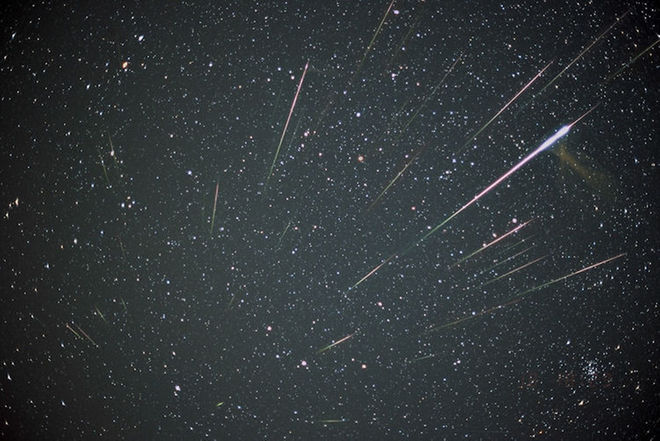
As every year, a shower of shooting stars, the Lyrids, will be visible, with the naked eye, the night of Sunday to Monday, April 23rd. On the night of Sunday, April 22nd, to Monday, April 23rd, early risers (or the night owls) will be able to observe up to 20 meteors per hour.
Lyrids last from April 16th to April 26th
All night long, while the moon will be unobtrusive, being in the increasing moon period, a meteor shower of the Lyrids will make the sky twinkle, as every year on the same date.
If the Lyrids last traditionally from April 16th to 26th, it is this weekend that the spectacle they make will be the most visible, this date corresponding to the peak in the intensity of the meteor swarm.
Thus, there will be no need for special equipment to observe the phenomenon, so it can be admired with the naked eye.
The phenomena known as Lyrids occurs due to the Comet Thatcher
As the Earth is getting closer to the long-lasting Comet Thatcher, the dust particles, debris, and small pieces dragged by the comet’s tail burn in our planet’s atmosphere and the friction forces, as those objects fall to Earth, increase their temperature making them look like fireballs.
To observe the Lyrids marvelous shooting stars and to count yourself among the lucky ones of that night, it will be necessary to get up early. Before sunrise, you have to locate the star Vega, which the brightest of the constellation of Lyra (which gave the Lyrids name).
For maximum visibility, stay away, of course, from city lights or other light pollution that would prevent you from clearly distinguishing the phenomenon.
If you don’t know where to look for the Lyrids, also known as April Lyrids, mobile apps like SkyView (Android/iOS) are available on smartphones to maximize the chances you look in the right place. Also, you might find these apps helpful for other astronomical events or to simply learn more about the constellations that glitter over our heads.