
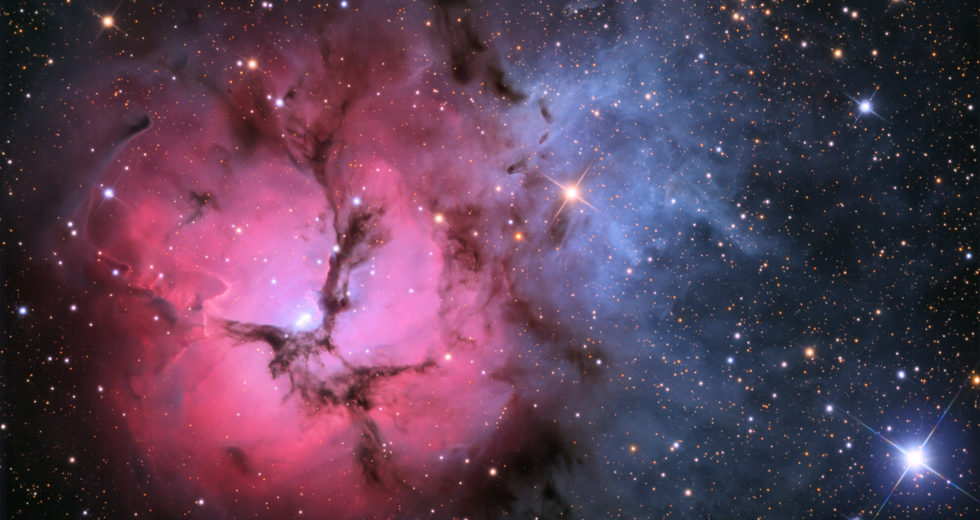
The Trifid Nebula is visible with small telescopes as a diffuse patch of light towards the constellation of Sagittarius, in the densest regions of the Milky Way. A team of astronomers based in Mexico, Italy and Spain have made new observations of the Trifid Nebula and revealed a complex area of star formations of about 300,000 years ago, the same age as Homo Sapiens.
The astronomy team compared the ground observational data with that taken by space telescopes
The Trifid nebula, discovered in 1764, includes a group of thousands of very young stars embedded in a nebula, which means a mixture of gas and dust particles, which constitutes the deposit of material to form future stars.
Its name refers to its most striking visual feature, namely, a nebula divided into three lobes by dark clouds of dense molecular material.
The team observed the central regions of Trifida with the OMEGA 2000 camera, mounted on the 3.5-meter telescope of the Calar Alto Observatory and compared its data in the near infrared spectrum with images taken from space.
“The OMEGA 2000 camera is undoubtedly one of the best instruments in the near infrared spectrum of the Northern Hemisphere,” says Carlos Roman-Zuniga, an astronomer at the National Autonomous University of Mexico (UNAM Ensenada) and one of the co-authors of the study.
By combining Calar Alto’s observations with the observation made from space, the astronomers have been able to scrutinize eight globules, also known as Trifid Condensions.
There are newborn stars in Trifid Nebula
Within these, they have found young stars. The stars proved to be newborn stars that can emit between 100 and 500 times the energy of the Sun, in total.
Spectacular phenomena related to star formation processes have also been detected, such as gas jets that emerge from both poles of these young stars.
Additionally, this study recalculated the distance between us and the Trifid Nebula and resulted that the Nebula is 20% further in the Universe than previously considered.
In conclusion, newborn stars of the same age as Homo Sapiens have been discovered in the Trifid Nebula.