
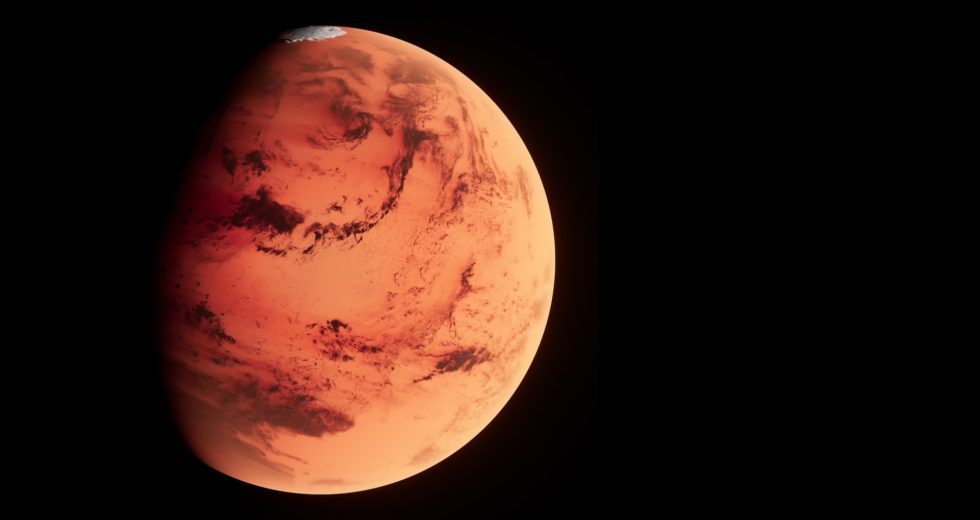
It is possible to be winter on Mars. Mars is tilted on its axis, just like Earth, so it experiences seasons similar to those on our planet. The length of a Martian year is about 687 Earth days, and during this time, the planet goes through cycles of winter, spring, summer, and fall.
The winter on Mars is characterized by colder temperatures, longer nights, and less sunlight. During the winter, the polar ice caps on Mars also grow larger as more ice and snow accumulate. The winter season on Mars is caused by the planet’s orbit around the sun, which is slightly more elliptical than Earth’s orbit. This means that the distance between Mars and the sun changes throughout the year, resulting in variations in the amount of sunlight the planet receives.
Is Santa a Martian?
Thanks to Europe’s Mars Express Probe, we can now feast our eyes on some of the frosty features that are present on our neighboring planet!
Mars terrain highlighted by frosty features in 'winter wonderland' image https://t.co/QAyL1H0Fu9 pic.twitter.com/OLVDzkD3kH
— SPACE.com (@SPACEdotcom) December 24, 2022
The Mars Express probe is a spacecraft that was launched by the European Space Agency (ESA) almost two decades ago, in 2003, with the goal of studying the planet Mars and searching for signs of water. The probe consists of an orbiter and a lander called the Beagle 2, which was designed to search for signs of past or present life on the planet.
The Mars Express orbiter has a number of scientific instruments on board, including a radar system called MARSIS (Mars Advanced Radar for Subsurface and Ionosphere Sounding), which is used to study the subsurface structure of Mars and search for underground water or ice.
It is important to note that the winter on Mars is much colder than the winter on Earth. The average temperature on our neighboring planet is about -80 degrees Fahrenheit (-62 degrees Celsius), and it can drop even lower during the winter.