It has been just revealed that a highly powerful cosmic ray has hit Earth and no one knows where this came from. Check out the latest reports about the matter to learn more interesting details.
Highly powerful cosmic ray hits Earth
It is a fact that Earth and space are constantly presenting us with perplexing questions and enigmatic occurrences.
Recently, a group of researchers studying Earth’s atmosphere made an astonishing discovery. It is rare for something truly “earth-shattering” to happen in our galaxy without experts being able to identify its source or reason.
However, last week, a potent cosmic ray hit our planet’s atmosphere without any apparent cause, leaving scientists puzzled. This event has completely baffled astrophysicists.
Experts are currently struggling to track the source of a cosmic ray, despite the particle carrying over 240 exa-electron volts of energy.
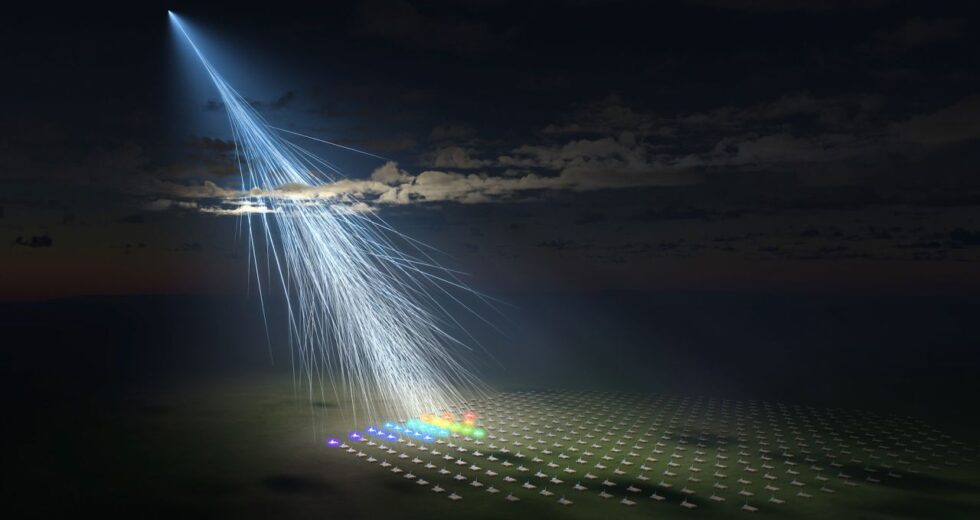
Physicist John Matthews from the University of Utah explained that these particles should not be affected by magnetic fields, and should be easily identifiable in the sky. However, once a cosmic ray hits the Earth’s atmosphere, it collides with other particles and creates a shower, which is then detected by observatories.
Matthews, who is part of the Telescope Array collaboration, stated that the energy level of this cosmic ray is second only to the ‘Oh-My-God’ particle.
This was detected back in 1991 at a colossal 320 exa-electron volts.
“But in the case of the Oh-My-God particle and this new particle, you trace its trajectory to its source and there’s nothing high energy enough to have produced it,” Matthews explained.
Experts commonly believe that cosmic rays are generated in energetic occurrences, such as supernovas and stellar collisions.
Less energetic sources, including stars like the Sun, can also produce lower-energy cosmic rays. The latest cosmic ray discovery was made by a research team who fittingly named the new particle Amaterasu, after the Shinto goddess of the sun.
Check out more details about the issue in the original article shared by Unilad.