The fastest way to improve sleep quality naturally costs nothing: get outside within 30 minutes of waking, eat your last meal three hours before bed, and keep your bedroom below 67°F. Those three levers determine whether sleep is restorative or just time in bed. Current AASM guidance (updated 2023) validates all three.
Why Sleep Quality Beats Sleep Quantity if You Want to Improve Sleep Naturally
You can spend nine hours in bed and wake up exhausted. Healthy adult sleep cycles through four stages every 90 minutes: N1, N2, N3 (slow-wave, physically restorative), and REM. Adults need roughly 20% slow-wave and 20-25% REM to function at capacity. Alcohol, heat, and untimed meals raise wake after sleep onset (WASO) without shortening time in bed. The targets that actually matter are sleep onset latency under 20 minutes and WASO under 30 minutes, not hours logged. If you want to improve sleep quality naturally, these two metrics are your scoreboard.
Morning Anchors That Reset Your Circadian Rhythm
Your circadian clock is set almost entirely by light. Charles Czeisler’s research at Harvard established that photoreceptors in the retina need direct outdoor light to anchor cortisol timing. The rule: 10 minutes outside within 30 minutes of waking, no sunglasses. Overcast days still deliver 10,000 lux versus 200-500 lux indoors with lights on. Skip this and your sleep window shifts later, a state called delayed sleep phase, and most people blame insomnia rather than cortisol timing.
Evening Protocol for Faster Sleep Onset
Caffeine has a half-life of 5 to 7 hours. A 3pm coffee leaves roughly 90mg of adenosine-blocking compounds circulating at 10pm. Move your cutoff to 1pm for two weeks before reaching for supplements. Second lever: dim overhead lights two hours before bed and switch to warm-spectrum bulbs (under 3000K) to reduce melatonin suppression. Third: digestion raises core body temperature, which must drop 1 to 2°F for sleep initiation to begin. Three hours before sleep is the minimum.
Bedroom Environment That Drops Your Core Temp
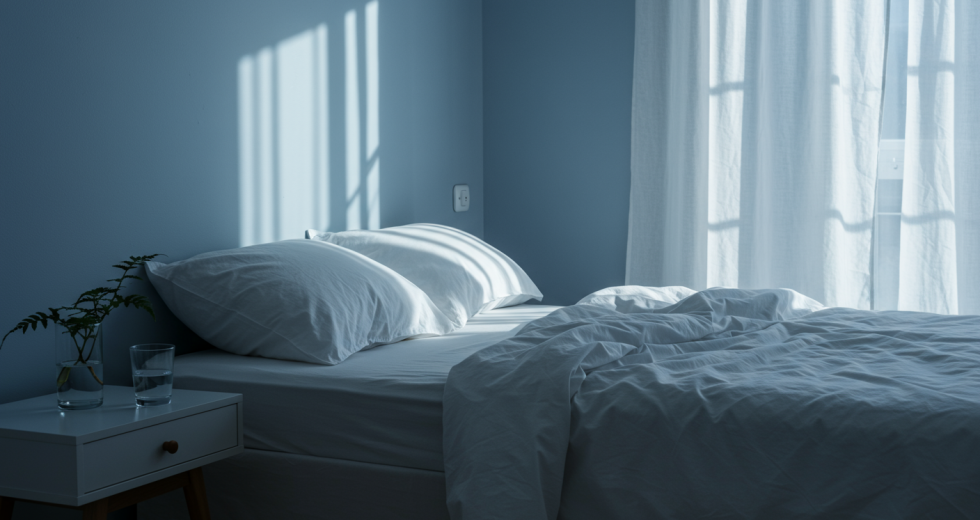
The American Academy of Sleep Medicine (AASM) recommends a sleep environment between 65 and 67°F. Most bedrooms sit at 70°F or above. The pattern I see most often is clients chasing supplements before addressing room temperature. Three changes make the biggest difference:
- Set a programmable thermostat to drop 4°F one hour before bed to accelerate your core temperature decline
- Install blackout curtains to eliminate light intrusion that suppresses melatonin after midnight
- Use a white noise machine at 65dB to mask variable ambient noise that causes micro-arousals
Supplements That Actually Help (And Ones That Do Not)
Three compounds have solid evidence. Magnesium glycinate at 200-400mg supports GABA receptor activity and reduces WASO; the guide to the best magnesium for sleep covers formulation differences. Glycine at 3g lowers core body temperature in controlled trials. Apigenin at 50mg binds GABA-A receptors mildly and is well-tolerated. Melatonin’s effective dose for sleep onset is 0.1 to 0.3mg, not the 5 to 10mg on US pharmacy shelves. Use it for jet lag. Prescription options like trazodone for sleep require physician oversight.
When to See a Sleep Doctor
Four weeks of trying to improve sleep quality naturally with no improvement points to obstructive sleep apnea. Use the STOP-Bang questionnaire; a score of 3 or above warrants a sleep study. Untreated apnea prevents slow-wave consolidation that no supplement replaces. Women in perimenopause face a distinct driver: estrogen and progesterone decline disrupts thermoregulation and GABA signaling at once. The hormonal picture is covered in the perimenopause waking at 3am guide.

How long until I see results from these sleep changes?
Sleep onset latency improves within 7 to 10 days of consistent morning light and caffeine cutoff changes. Full circadian recalibration, where WASO and slow-wave ratios normalize, takes 3 to 4 weeks. Supplements at the correct dose show effect within the first week.
Is melatonin safe to take every night?
Low doses (0.1 to 0.5mg) are considered safe short-term. The 5 to 10mg doses standard in US supplements lack long-term safety data and may suppress endogenous production. The AASM does not recommend melatonin as a primary treatment for chronic insomnia.
Why do I wake up at 3am and cannot get back to sleep?
Three causes dominate: a cortisol spike from blood sugar instability, sleep apnea causing a micro-arousal, or progesterone decline in women over 40 reducing GABA-mediated sleep depth. Alcohol is a frequent fourth, fragmenting sleep in the second half as it metabolizes.
Does alcohol improve or hurt sleep quality?
Alcohol reduces sleep onset latency but suppresses REM in the first half of the night and causes rebound arousal in the second half. The net result: significantly increased WASO, reduced REM percentage, and lower sleep quality the next morning regardless of total hours slept.