
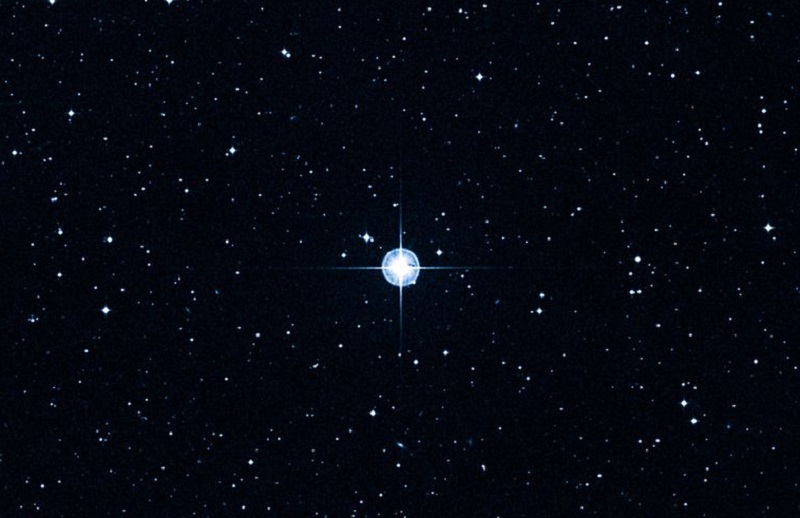
Przybylski’s star or HD 101065 is considered the strangest star in the Universe due to its rare chemical composition. Even more, recent observations showed that this weird star also possesses bizarre rotation characteristics.
The Przybylski’s star was discovered in 1960. Since then, the astronomers have been fascinated by the star’s unique chemical composition, formed by extremely rare elements.
According to this recent report, some of the observations made by the experts from the Astrophysics Institute in Potsdam, in Germany, have unveiled that HD 101065 is both composed of strange chemicals and possess equally bizarre rotation characteristics.
The Przybylski’s star or HD 101065 makes a full rotation around its own axis in about two centuries
With the High Accuracy Radial Velocity Planet Searcher, located within the Chilean ESO telescope facility, the researchers analyzed the magnetic field of the star and its rotation period.
The results of the study indicate that this star is able to perform a complete rotation around its own axis in about two centuries.
”Our analysis suggests that this star’s rotation is extremely slow,” said the astronomers in their report. They estimated that the star performs a complete rotation around its own axis once every 188 years.
The rare chemical composition of the Przybylski’s star still baffles the scientists
According to astronomers, the star’s long rotation makes this space object a so-called Ap Star. An Ap Star is that type of stars which possesses rare chemical composition and presents a slow rotation around its own axis.
Ap Stars are considered very special because scientists cannot detect all the types of the chemicals found in their composition by analyzing the star’s spectrum.
In the case of HD 101065, there are unusual amounts of iron and nickel, as well as rare elements such as strontium, cesium, and neodymium, among others. Also, the so-called Przybylski’s star, dubbed as the strangest star in the Universe, is the only star which contains the extremely rare elements called actinides.
✅ Key Takeaways
Przybylski's Star remains one of the most chemically peculiar objects in observable astronomy. Its impossible cocktail of short-lived radioactive elements challenges our understanding of stellar nucleosynthesis and continues to generate debate among astrophysicists about whether natural processes alone can account for its composition.
❓ Frequently Asked Questions
Why is Przybylski's Star so unusual?
Przybylski's Star (HD 101065) contains abnormally high concentrations of rare earth elements and short-lived radioactive elements like promethium, einsteinium, and plutonium. Since these elements decay quickly on astronomical timescales, their presence suggests an unknown nuclear process or possible external contamination source that science has not yet fully explained.
Could Przybylski's Star be evidence of an advanced civilization?
Some astrophysicists, including the late physicist Alexander Shatunov, have speculated that the anomalous element signatures could theoretically indicate industrial nuclear waste from an advanced civilization. However, most astronomers consider natural explanations more likely, including unusual stellar nucleosynthesis or accretion from a companion object.
Where is Przybylski's Star located?
Przybylski's Star is located approximately 370 light-years from Earth in the constellation Centaurus. It was first identified as peculiar by the Polish-Australian astronomer Antoni Przybylski in 1961, and subsequent spectroscopic analysis confirmed its extraordinary chemical composition.
How fast does Przybylski's Star rotate?
Przybylski's Star has an exceptionally slow rotation period of approximately 188 years, making it one of the slowest rotating stars known. This extreme slowness contributes to strong chemical stratification in its atmosphere, which may partially explain the unusual element concentrations observed in its spectrum.