
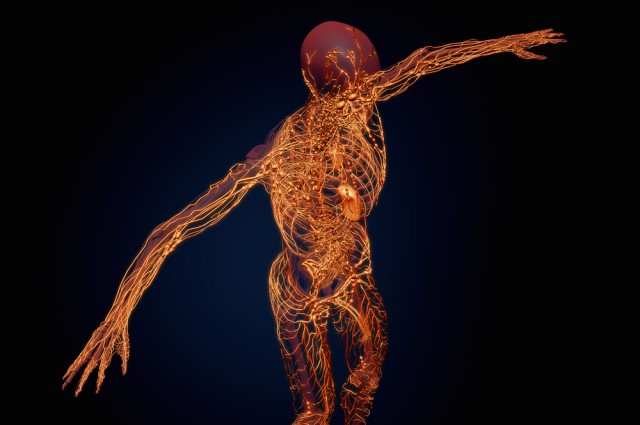
Scientists from the School of Medicine of the University of New York, in the USA, have discovered a hitherto unknown organ, the Interstitium. According to the study, the connective tissue beneath the surface of the skin that lines the digestive tract, lungs, urinary systems, veins, and arteries is made of interconnected compartments filled with fluid and not a dense layer, as the science taught us in schools.
The new organ is present everywhere, from internal organs to veins
These compartments are supported by a network of strong connective tissue proteins (collagen) and flexible ones (elastin) and can act as shock absorbers that prevent tissues from tearing as organs, muscles, and vessels are compressed, pump or beat.
For researchers, this finding could also explain why cancer cells spread further in the body as this layer is liquid and not solid and is found anywhere in the body.
In addition, the study revealed that “the cells that reside in that space and the collagen bundles that they cover change with age and can contribute to skin wrinkles, limb stiffness and the progression of sclerotic and inflammatory diseases.”
However, scientists have presumed for a long time that half of the fluids in the body should reside in the interstitial layers but this new study is the first in the world to show that the interstice is an organ itself and, along with the skin, is one of the largest in the body.
This new discovery will drive great advances in medicine
Neil Theise, a professor at the School of Medicine of the University of New York and the new study’s author, explained that this new organ, the Interstitium, has not been discovered before due to the fact that scientists tend to examine fixed tissue.
“Scientists prepare the tissue for examination by treating it with chemicals in order to highlight the main features but this treatment drains any fluid,” added Neil Theise.
During this study, the scientists used a high-end technology named “confocal laser endomicroscopy” which offers a microscopic view of living tissues.
“This discovery has the potential to drive great advances in medicine, including the possibility of interstitial fluid becoming a powerful diagnostic tool,” concluded Neil Theise said.
In conclusion, the scientists have discovered a hitherto unknown organ, the Interstitium, and this finding can open new roads in medicine.